
‘Tis the season for making mid-season soybean management decisions. One of those decisions is the use of foliar fertilizers which supply nutrients to the plant through the leaves. We do know that foliar fertilizers can be effective at remedying visual nutrient deficiencies, but what if there are no nutrient deficiencies present?
Our national Science for Success team of experts at land-grant institutions evaluated common foliar fertilizer products applied at R3 (beginning pod) in 46 sites across 16 states to determine the impact on soybean yield and quality (protein and oil). When you look across these sites, which captured wide variability in soil type, yield levels and environmental conditions, these products did not affect soybean yield or quality. If you drilled down into individual environments, foliar fertilizers only impacted yield in four of the 46 environments with no consistent reason for impact. Previous work in Iowa, Michigan, Minnesota and Ohio also showed a low frequency of foliar fertilizers impacting soybean yield. In our national study, some nutrient (Ca, Mn, B) concentrations did increase in the soybean plant (identified by tissue sampling) post application of these foliar fertilizer products, but those concentration increases did not translate into increased yield. More information from this trial and the referenced trials from other states can be found here.
When considering this production practice, it is important to note that the nutrient demand for soybeans at a reasonable yield level generally well exceeds the supply from a foliar fertilizer product. Let’s take potassium (K) for example. A 60 bu/A soybean crop will uptake around 140 lbs K, but many of these foliar fertilizer products only supply a couple of pounds of that nutrient in an application.
Our goal with conducting coordinated research across the nation at many sites is to capture lots of environmental variability to strengthen the confidence in our recommendations. This is an example where many sites of research consistently showed no impact of foliar fertilizer use on soybean yield or quality when applied at R3 without a visual nutrient deficiency issue.
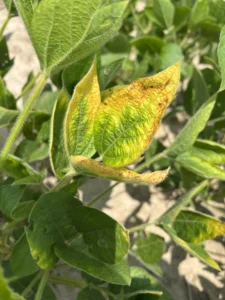
Photo Credit: Stephanie Porter, ISA
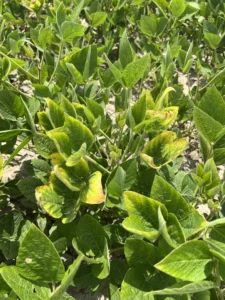
Photo Credit: Stephanie Porter, ISA
References
Bender et al., Modern Soybean Varieties Nutrient Uptake Patterns. University of Illinois Urbana-Champaign
Modern Soybean Varieties’ Nutrient Uptake Patterns
Matcham et al., Foliar Fertilizers Rarely Increase Yield in U.S. Soybeans. Science for Success
https://resources.ipmcenters.org/resource.cfm?rid=45271&vid=30391
Matcham et al., Foliar Fertilizers Rarely Increase Yield in United States Soybeans. Agronomy Journal
https://acsess.onlinelibrary.wiley.com/doi/10.1002/agj2.20889

Rachel Vann is a Cropping Systems Agronomist and Extension Specialist in the Crop Sciences Department at the University of Illinois Urbana-Champaign. She is dedicated to advancing effective cropping systems through innovative research, interdisciplinary collaboration, and impactful outreach. Her work focuses on improving row crop management and integrating specialty grain crops into diverse rotations to enhance agricultural resilience and productivity. Rachel serves as the Principle Investigator of the Science for Success initiative which brings together more than 25 soybean Extension experts from across the United States to collaboratively deliver soybean best management practices. Prior to working at UIUC, Rachel was an Associate Professor and Soybean Extension Specialist at NC State University.


 and then
FIND US ON