
Refining management decisions throughout the growing season was a key focus of the 2026 Midwest Agronomy Day hosted by BRANDT at the Evelyn Brandt Thomas Ag Innovation Center in Pleasant Plains, Illinois, last week. In the research plots surrounding the ag center, BRANDT team members discussed the why and how behind practices ranging from soybean genetics to spray applications. Closing out the event, Dr. Dan Quinn, Extension Corn Specialist at Purdue University, discussed high-yield corn management strategies and the role of foliar fungicides, a timely topic as farmers evaluate crop conditions and consider an application.
Before getting to those in-season decisions, let’s start at the beginning: seed selection. Technical agronomists Brian Dintelmann and Kyle McClelland discussed soybean genetics coming down the pipeline as well as the current state of the soybean breeding industry. In the private sector, only six major companies are currently breeding soybeans in the U.S., making it important to understand the genetics they offer, how they perform in Illinois fields and how they respond to Illinois farmers’ management.
This will be especially important for two new soybean trait packages that farmers will soon have access to: Vyconic and Enlist E3® with Nemasphere™. Vyconic soybeans, which could be available as early as 2028, are being developed with tolerance to five herbicides: glyphosate, glufosinate, dicamba, 2,4-D and mesotrione. Expanding on the XtendFlex® trait platform, Vyconic beans are expected to provide farmers with greater herbicide flexibility and more postemergence treatment options.
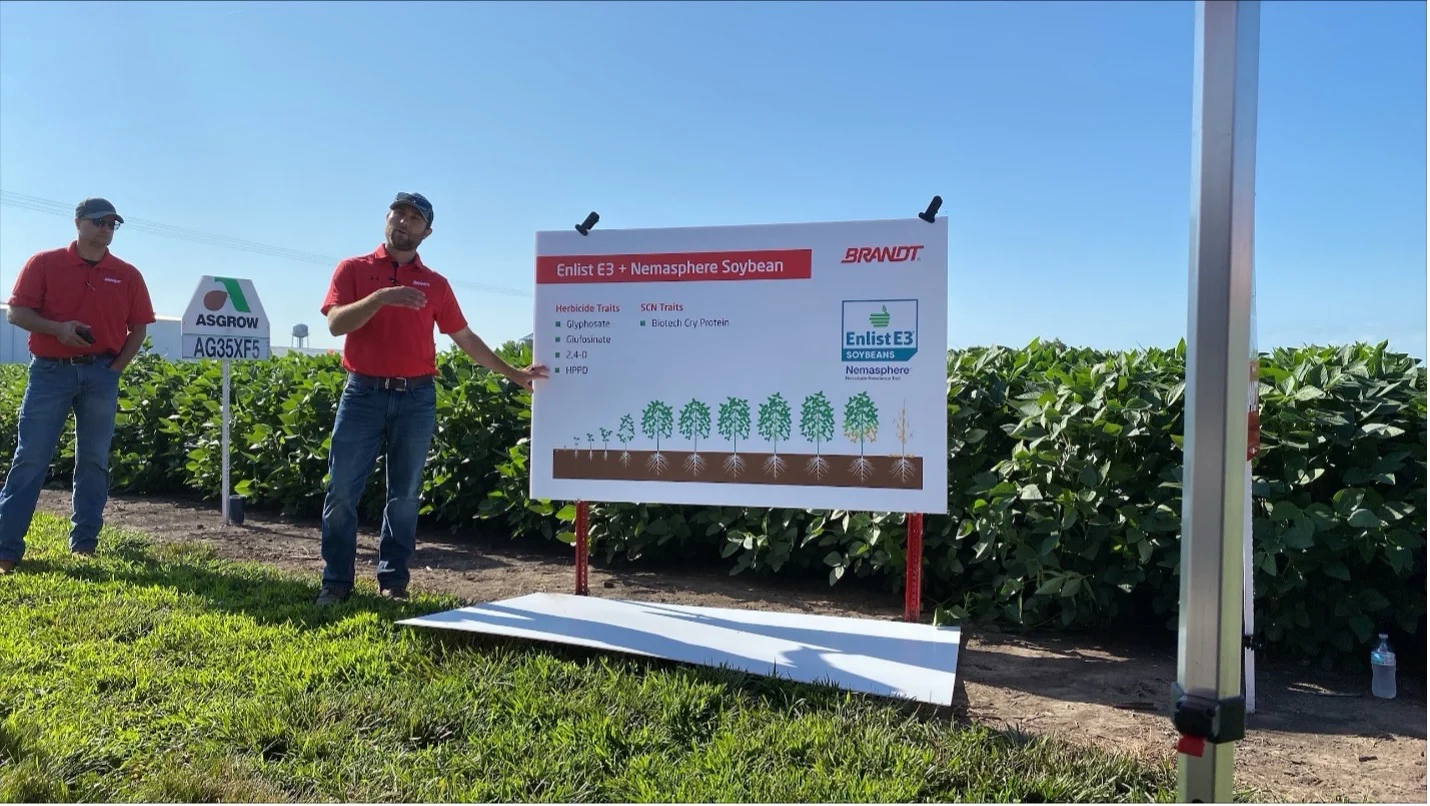
Building on the Enlist E3 platform, Enlist E3 soybeans with Nemasphere are expected to add a new transgenic trait for soybean cyst nematode (SCN) resistance in addition to tolerance to HPPD herbicides. Together, these innovations are intended to expand growers’ options for weed control and provide an additional tool for managing SCN. However, these BRANDT agronomists are cautiously optimistic about the new trait stacks, as broader herbicide flexibility cannot come at the expense of yield potential.
Continuing on the theme of weed management, Dr. Eric Winans, Director of Agronomy for Discovery and Innovation, and Adam Ivey, Senior Director of Specialty Formulations, discussed spray application performance and the efficiency of herbicides, fungicides and insecticides. They highlighted a few main factors that can influence spray performance: water pH, product dispersion, translocation and droplet size.
To maximize product efficacy, the water used in a tank mix should be slightly acidic, ideally between a pH of 4.5 and 6. When water is more alkaline, some sensitive active ingredients in the product mix can break down more quickly through a process called alkaline hydrolysis, which can dramatically reduce a product’s half-life. Adjuvants such as water acidifiers, dispersing agents, translocation aids and drift reduction agents can help improve spray performance.
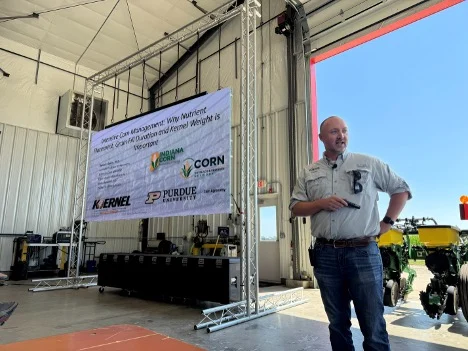
While most farmers have completed their herbicide applications for this cropping season, there is still time to decide whether to apply a foliar fungicide. In Quinn’s presentation on how corn yield is influenced by management throughout the growing season, he explained the impact a fungicide can have. Many farmers have heard that foliar fungicides can positively influence corn yield, and may even be familiar with the “stay green” effect, but what is happening physiologically within the plant to influence yields?
Quinn explained that late-season plant health heavily influences one of the three components of corn yield: kernel weight. Sink capacity, or the potential size of each kernel, is determined at R2, but plant health through physiological maturity will ultimately determine final kernel weight. According to recent data from Purdue, only 39% of the grain dry weight has accumulated by R5, meaning that 61% of grain fill occurs between R5 and R6.
Therefore, maintaining photosynthetic activity and canopy health is essential to push yields to the next level. According to research conducted by Quinn at Purdue, foliar fungicide applications at R1 can extend grain fill by four or five days, leading to higher kernel weights, and therefore, higher yields. In Quinn’s research, this extension of grain fill led to a 10-bushel yield increase.
Furthermore, adding fertility to your fungicide can further increase corn yield potential. Additional research Quinn conducted in West Lafayette, Indiana, showed that the addition of potassium and boron at R1 with fungicide increased corn grain yield by 7 bushels over fungicide alone.
While Quinn emphasized that corn yield is built throughout the growing season, he also highlighted that growers can do everything right to set the plant up for success and still lose yield during the grain-fill period. This event demonstrated that every management decision provides an opportunity to protect yield potential, and even in late July, there are still decisions left to make.
About the Author: Darby Danzl



 and then
FIND US ON