
Author: Torey Colburn, CCA-IL, 4R NMS, Ssp – Midwest Conservation Agronomist, American Farmland Trust
—
Herbicide Carryover and Cover Crops: Understanding the Risk
The agronomics of producing corn and soybeans can be very simple. They can also be very complex. Producers are constantly juggling different management considerations and input options year after year. It can be overwhelming and frustrating when something doesn’t pan out as expected.
As a certified crop advisor, it has always been my mission to help producers make informed decisions. That doesn’t mean we always make the right decision or that some unforeseen factor doesn’t get a say in the equation. But I do my best to provide farmers with information that helps them have greater confidence in the decisions they make.
Over the course of my career, I’ve put a lot of miles on these legs and worn out countless pairs of boots walking fields, diagnosing production issues, and helping farmers work through them. In that time, I’ve found that one of the more difficult problems to diagnose can be herbicide injury, particularly herbicide carryover injury.
Herbicide carryover generally refers to a situation where a herbicide applied to a previous crop causes injury to a subsequent crop. Despite extensive research and label guidance intended to minimize this risk, carryover still happens. It’s part of life in row-crop agriculture.
When cover crops enter the picture, another layer of complexity comes with them. The effects of herbicide programs on cover crop species aren’t always as well understood as their effects on corn and soybeans. As interest in cover crops continues to grow, understanding how residual herbicides may affect their establishment becomes increasingly important.
When Cover Crops Struggle, Look Beyond Planting Conditions
When a cover crop fails to establish as expected, we often look first at familiar culprits: dry weather, poor seed-to-soil contact, or unfavorable planting conditions. Those factors certainly matter, but herbicide carryover may be another piece of the puzzle.
Carryover injury isn’t always easy to identify. Symptoms can be difficult to distinguish from environmental stress, and the effects may vary depending on the herbicide, the cover crop species, and conditions in the field. That doesn’t mean herbicide carryover is responsible every time a cover crop struggles. It does mean the herbicide history deserves consideration when trying to understand what went wrong.
Sometimes, understanding what went wrong means looking back at the previous season’s management decisions. In the video below, I share a field example where a cereal rye cover crop failed to establish following a corn crop, despite a history of successful cover crop establishment on the farm. It’s a reminder that herbicide carryover can present some unexpected challenges, even for experienced farmers.
What Influences Carryover Risk?
There isn’t one factor that determines whether a residual herbicide will affect a cover crop. Risk depends on the herbicide itself, the soil and weather conditions it encounters, and the time available for degradation.
Some herbicides persist longer than others, and environmental conditions can influence how quickly they break down. Cool or dry weather, for example, can slow degradation and leave less time for herbicide residues to dissipate before fall cover crop planting. Soil properties and management practices can influence that process as well.
Application timing is another important consideration, particularly when post-emergence applications occur later in the growing season. And the cover crop species matters: a herbicide program that poses little risk to one species may be more problematic for another.
These factors interact, which is why carryover risk can vary from one field or growing season to the next. Understanding those differences can help farmers evaluate their options before planting and troubleshoot problems when establishment doesn’t go as planned.
Making More Informed Decisions
The good news is that understanding carryover risk can help inform management decisions. When planning cover crops, consider the herbicide program alongside the intended species and planting date. When establishment problems arise, look at the whole picture rather than assuming planting conditions tell the entire story.
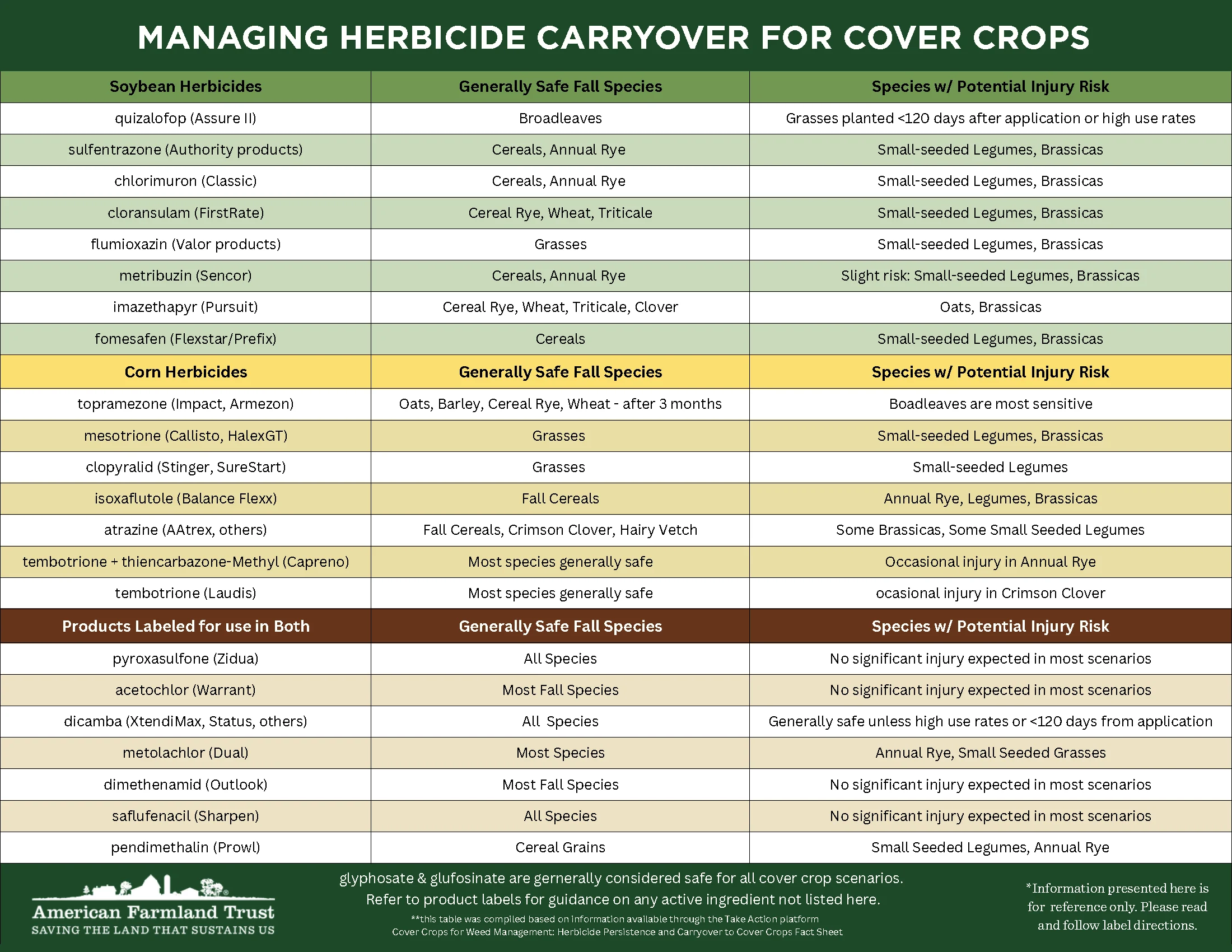
To help farmers work through these considerations, I developed Managing Herbicide Carryover for Cover Crops through my position as Midwest Conservation Agronomist with American Farmland Trust. This guide is intended as a practical reference guide that examines factors influencing carryover risk and compares commonly used corn and soybean herbicides with fall cover crop species that may be more or less susceptible to injury.
The guide is intended as a starting point for evaluating risk, not a guarantee of how a particular cover crop will respond. Product labels and product-specific guidance remain essential when making management decisions.
We can’t control every factor that influences cover crop establishment, and we won’t always get every decision right. But understanding the risks gives us a better starting point—and a better chance of learning from the outcome when things don’t go as planned.



 and then
FIND US ON