
There has been an explosion of Red Crown Rot (RCR) information in the media over the past few years. The focus on RCR has been justified, necessary and beneficial. I have been in the middle of that “educational surge” and am glad I have been. When RCR appears in an area, it represents a very real concern and can present danger to yield and income, cutting yields by 40 to 60% or more. The grower encountering RCR for the first time needs to be prepared. Yet, that uptick in awareness also comes with potential risk. Bluntly stated, we run the risk of misdiagnosis. We run the risk that folks may inadvertently “cry wolf.”
This is not a new problem. Education around emerging crop pests has always driven a certain degree of unintentional misdiagnosis. It drives an increase in crop scouting. Upticks in scouting and heightened sensitivity to a new pest suddenly bring us into contact with common, annual soybean diseases that have simply gone unnoticed. Combine those suddenly observed diseases with RCR publicity, and we find ourselves ripe for some disease being misdiagnosed as RCR.
Why become anxious about individuals incorrectly calling something “Red Crown Rot?” The answer goes back to the children’s story, “The Boy Who Cried Wolf.” We run the risk that repeated cries of “Red Crown Rot” could be made so often that growers delay investigation of an actual case of RCR. The boy cried “wolf” so many times that help didn’t come when the real wolf truly arrived. If we should introduce “Red Crown Rot panic” rather than “Red Crown Rot respect,” industry response could follow the parable.
So, what should one do when encountering something odd in the field? What should one do when those discoveries make the mind drift to the possibility of RCR?
First, take a deep breath. Remember, getting disease identified correctly is essential. An effective strategy always requires that we know our enemy well. Mentally discipline yourself to say the words, “maybe it is” rather than, “I am sure it is” when you are anxious about RCR.
Second, remember that yellow SDS-like mottling of the leaves and red discoloration of the lower stem increases the chances that you are encountering RCR, BUT it does not definitively identify disease as RCR. Other things can redden lower stems and mottle leaves.
Third, remember that RCR diagnosis in the field requires observation of those bright red, pinpoint-sized fruiting bodies just above, at, and just below the soil line. Minus the observation of those structures (termed “perithecia”), we cannot be sure we are encountering RCR.
Fourth, if you are still unsure, always consider submitting a sample to the U of I Plant Clinic. Illinois Farmers can receive free red crown rot testing by going to “Free RCR Testing” located under the “Participate” tab on FieldAdvisor.org. If you do so, do not panic, cry “Red Crown Rot,” and spread rumors across the countryside. Submit samples and calmly wait for words confirming the disease or diseases isolated from collected from plants. We want to introduce healthy respect, not panic.
Remember, don’t cry “Wolf/ Red Crown Rot” haphazardly. Do the necessary diagnostic steps and treat the disease with respect rather than panic. You want folks to take RCR seriously when the real deal arrives. We cannot afford to lull people into complacency on this one.
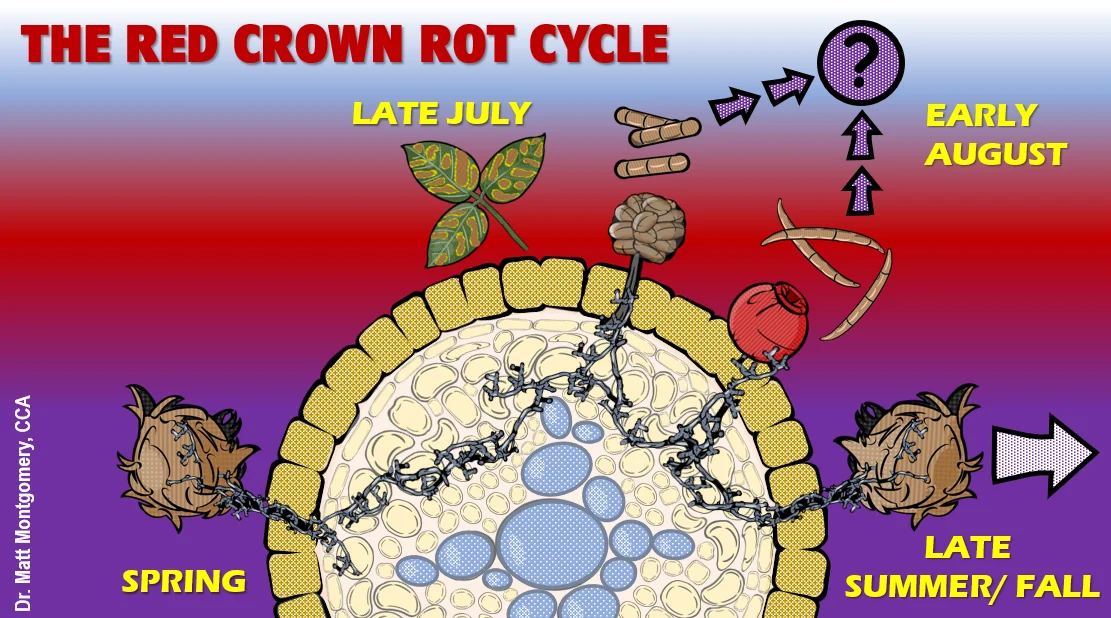
Diagram courtesy of Matt Montgomery, CCA, IL Soy Envoy

Matt Montgomery is the agronomy education lead at Beck’s Hybrids and resides in Chatham, Illinois. He earned his bachelor’s degree in agriculture from Western Illinois University, followed by a master’s and doctorate from the University of Illinois. Montgomery spent nearly 19 years in an agronomy role with University of Illinois Extension before transitioning to the seed industry. His significant contributions to the field were recognized in December 2024 when he received the Illinois Certified Crop Adviser Award, honoring his exceptional service in nutrient management and crop production. He was also named International Certified Crop Adviser of the Year in 2025. Matt is a 2025 IL Soy Envoy.


 and then
FIND US ON