
This article was originally posted in the June 2026 issue of AgroPages Magazine here, with a featured interview from Stephanie Porter, ISA Outreach Agronomist.
Red Crown Rot (RCR) has emerged as a significant threat to soybean production in the United States, expanding northward from traditional southern strongholds into the Midwest. To provide farmers and industry stakeholders with current, expert-grounded guidance on RCR management, six specialists representing academic institutions, agricultural associations, and agrochemical companies were interviewed.
Stephanie Porter, Outreach Agronomist for the Illinois Soybean Association (ISA), draws on extensive grower feedback through the ISA Growing Concerns Survey, documenting yield losses of 20–50% in affected field areas. From the university sector, Martin Chilvers, Professor of Plant Pathology and Extension Specialist at Michigan State University, and Carl Bradley, Professor of Plant Pathology and Extension Specialist at the University of Kentucky, contribute complementary perspectives grounded in multistate field research, controlled laboratory work, and fungicide efficacy trials. Both emphasize the importance of accurate diagnosis, characterization of variety responses, and integrated management approaches.
From the seed treatment industry, Leo Zappe, Global Portfolio Management Seedcare & Biologicals, and Jader Caricati, Global Product Management Lead – Seedcare, both from Syngenta, discuss the development and performance of VICTRATO® and SALTRO®, including their effectiveness across diverse Midwest environments and interactions with broader soilborne disease complexes. Willem-Jan Meulemeesters, General Manager of Gowan Netherlands, represents the biological seed treatment perspective, specifically addressing CeraMax® and natamycin-based approaches.
The interviews reveal several consistent themes. First, accurate diagnosis remains challenging, as RCR symptoms closely resemble Sudden Death Syndrome (SDS) and other soilborne diseases, requiring hands-on scouting and laboratory confirmation. Second, seed treatments remain the most reliable near-term control, with products such as VICTRATO® and SALTRO® demonstrating strong performance in field trials, though efficacy varies by location and growing conditions. Third, integrated management—combining chemistry, genetics, cultural practices, and proper field monitoring—offers the most durable path forward.
Facts & Figures
- Pathogen: Calonectria ilicicola
- Disease Type: Soilborne fungal disease
- Plant Part Affected: Roots and lower stems; foliar symptoms are secondary
- Symptom Appearance: R3–R4 growth stages (early reproductive)
- Diagnostic Sign: Red/maroon discoloration and red perithecia at stem base
- Yield Loss Range: 15–80% (field-dependent; 20–50% typical in the Midwest)
- Pathogen Persistence: Microsclerotia survive 5–7 years in soil
- Favorable Conditions: Wet soils, poor drainage, compaction, plant stress
- Geographic Distribution: Southeastern U.S. (endemic); Midwest (emerging in seven or more states as of 2026)
- Current Best Practice: Match seed treatment selection with field history and disease pressure
- Available Solutions: VICTRATO®, SALTRO®, ILEVO®, CeraMax®
Interview with Stephanie Porter
Outreach Agronomist, Illinois Soybean Association
As Red Crown Rot expands its footprint from the South into the Midwest, how would you characterize the current threat level to soybean production? In your view, what makes this pathogen uniquely difficult to manage compared to other established soilborne diseases like Sudden Death Syndrome (SDS)?
In Illinois, Red Crown Rot is considered a high threat based on responses from hundreds of farmers participating in the Illinois Soybean Association Growing Concerns Survey. Once established, the disease can cause yield losses ranging from 20% to 50% in affected areas of a field, depending on environmental conditions during the growing season.
Managing RCR is difficult because researchers are still learning about the disease triangle—the interactions among the pathogen, host, and environment that favor disease development. An often-overlooked aspect of Calonectria ilicicola is its broad host range. Several known plant species, including alfalfa, clovers, peanuts, and certain woody plants, can serve as alternate hosts. Additional unidentified host plants in Illinois may also contribute to disease persistence and spread.
How can farmers better differentiate between early-season RCR symptoms and other common root rots, and how does this diagnostic challenge complicate your outreach and management advice?
Distinguishing RCR from other soybean diseases can be difficult because aboveground symptoms such as interveinal chlorosis and necrosis closely resemble those of SDS, brown stem rot, and stem canker.
Accurate diagnosis requires in-field scouting around soybean growth stages R3 to R4. At this time, plants should be dug up and examined at the crown. Growers should look for the characteristic reddish discoloration and small red fungal structures known as perithecia at the stem base. However, these signs may not always be visible due to growth stage timing or moisture conditions.
Scouting is especially challenging from mid-July through mid-August because symptoms are often scattered and subtle. Infected plants may appear as isolated chlorotic, necrotic, or wilting individuals rather than large, obvious field patterns. By late August and September, infected plants are often dead and severely decomposed, making diagnosis difficult and causing symptoms to resemble generalized black rot.
The challenge is compounded by the fact that multiple diseases frequently occur in the same plants, while microsclerotia can spread through wind, water, birds, and farm equipment. These factors make timely diagnosis difficult and require agronomists to emphasize hands-on scouting and laboratory confirmation when providing management recommendations.
You have identified seed treatments as the most effective current defense, yet we see varying levels of performance in the field. From an agronomic perspective, what specific characteristics should a grower look for in a seed treatment package to ensure optimal RCR suppression? Furthermore, in cases where early-season pressure is extremely high, how are you guiding farmers to prioritize seed treatment selection alongside other risk-management tools?
University of Illinois field trials supported by Illinois Soybean Association checkoff funding demonstrate that fungicide seed treatment performance against RCR varies considerably depending on product selection and environmental conditions.
Among currently registered seed treatments, SALTRO® consistently delivered the most effective disease suppression and strongest yield protection in RCR-infested fields. ILEVO® and CeraMax® also provided measurable benefits, although performance varied more significantly across locations.
These findings emphasize the importance of early-season protection. Infections occurring shortly after planting generally result in the greatest yield losses, although disease development through the R1 growth stage can still significantly impact productivity.
For fields with a known history of RCR, growers are encouraged to select proven fungicide seed treatments, with SALTRO® standing out as a reliable option for disease control and yield preservation. However, VICTRATO® (Tymirium), the newest treatment available, is emerging as the most effective overall option in recent university trials and has occasionally outperformed SALTRO®.
What specific cultural or management practices are showing the most promise in your recent ISA-led discussions, in addition to seed treatments?
Growers should avoid rotations involving alternate host crops such as clover and alfalfa, as these species can increase pathogen inoculum levels in the soil.
Rotation with corn may reduce disease pressure but will not eliminate the pathogen, which can survive for years in the soil. Research supported by the Illinois Soybean Association using satellite and drone imagery has shown that RCR frequently develops in low-lying areas and patchy field zones. Over time, disease spread across a field may be limited through no-till management practices.
Because the disease thrives in wet soils, improving field drainage is recommended. The pathogen can potentially spread through birds, deer, machinery, and water movement, making equipment sanitation an important preventive measure.
When environmental conditions favor disease development, symptom severity often increases when soybeans are stressed by other factors such as soil compaction. Therefore, minimizing plant stress is strongly encouraged.
Research examining interactions between RCR and soybean cyst nematode (SCN) is ongoing, with additional field results expected.
Beyond current chemical seed treatments, where do you see the next breakthrough in RCR management coming from? Are we looking toward new biologicals, precision detection technologies, or perhaps gene-editing for true varietal resistance in the next 3–5 years?
Illinois Soybean Association-funded research has successfully paired satellite and drone imagery with field disease measurements to train machine-learning models capable of detecting canopy-level disease patterns. These models are being applied to commercial fields to identify disease hotspots and support field scouting and research trial placement.
Biological product evaluations conducted in growth chamber and greenhouse studies indicate that biological treatments alone cannot reliably control RCR or replace proven chemical seed treatments. While some products demonstrated limited activity, none consistently provided meaningful protection beyond standard fungicidal seed treatments. For fields with a history of RCR, growers should continue to prioritize chemical seed treatments, viewing biological products only as potential supplements if future products demonstrate significant benefits.
Looking ahead, the greatest opportunity may come through gene-editing technologies and the development of true varietal resistance. Currently, no highly resistant soybean varieties exist, although differences in tolerance have been observed among varieties. Future research should focus on identifying rare resistance alleles within soybean germplasm collections and improving screening methodologies.
Additional research is also needed to better understand disease epidemiology and identify alternative host species that may contribute to pathogen survival and spread.
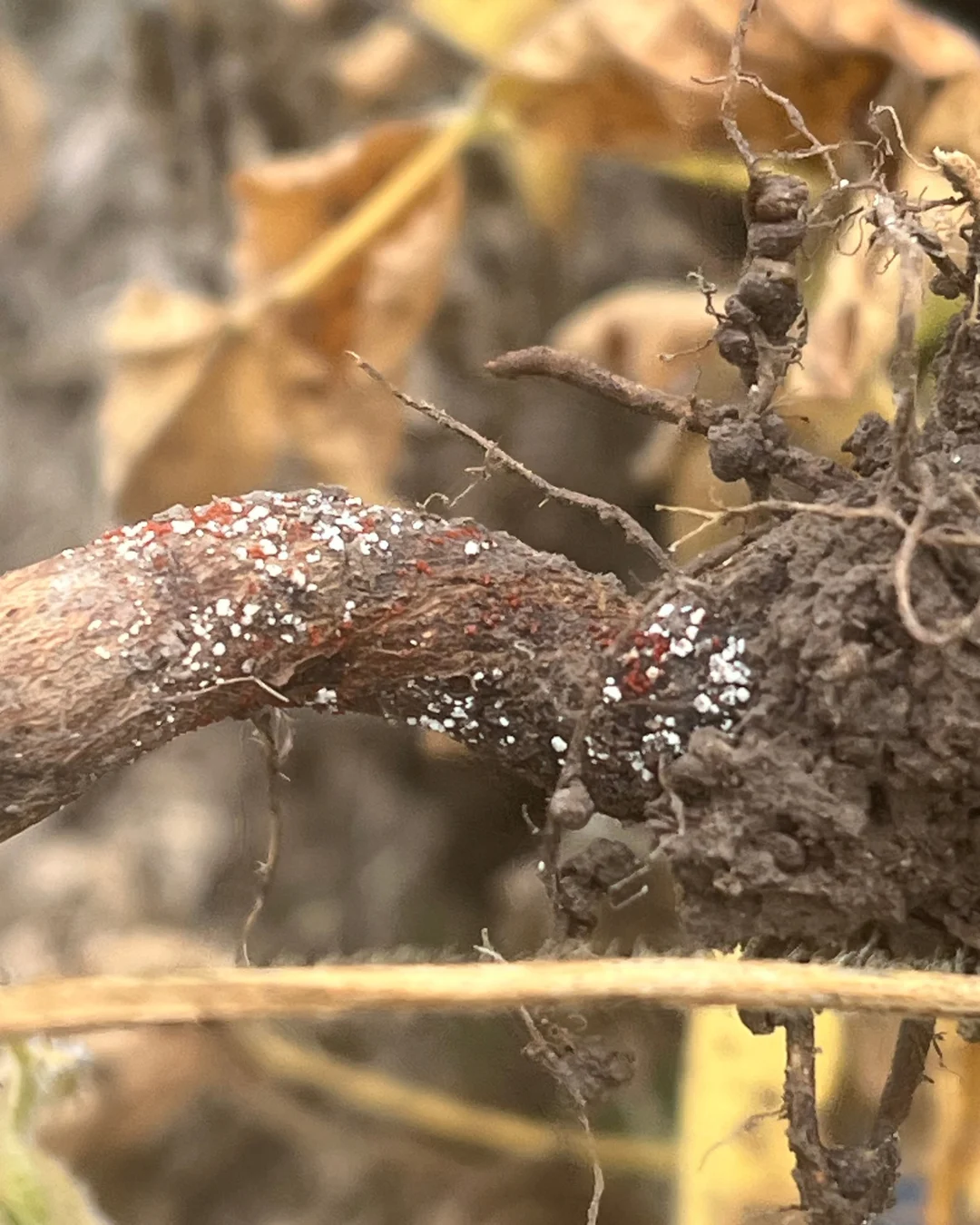
Red crown rot has caused significant damage to soybean cultivation.
Photo Credit: Stephanie Porter, ISA
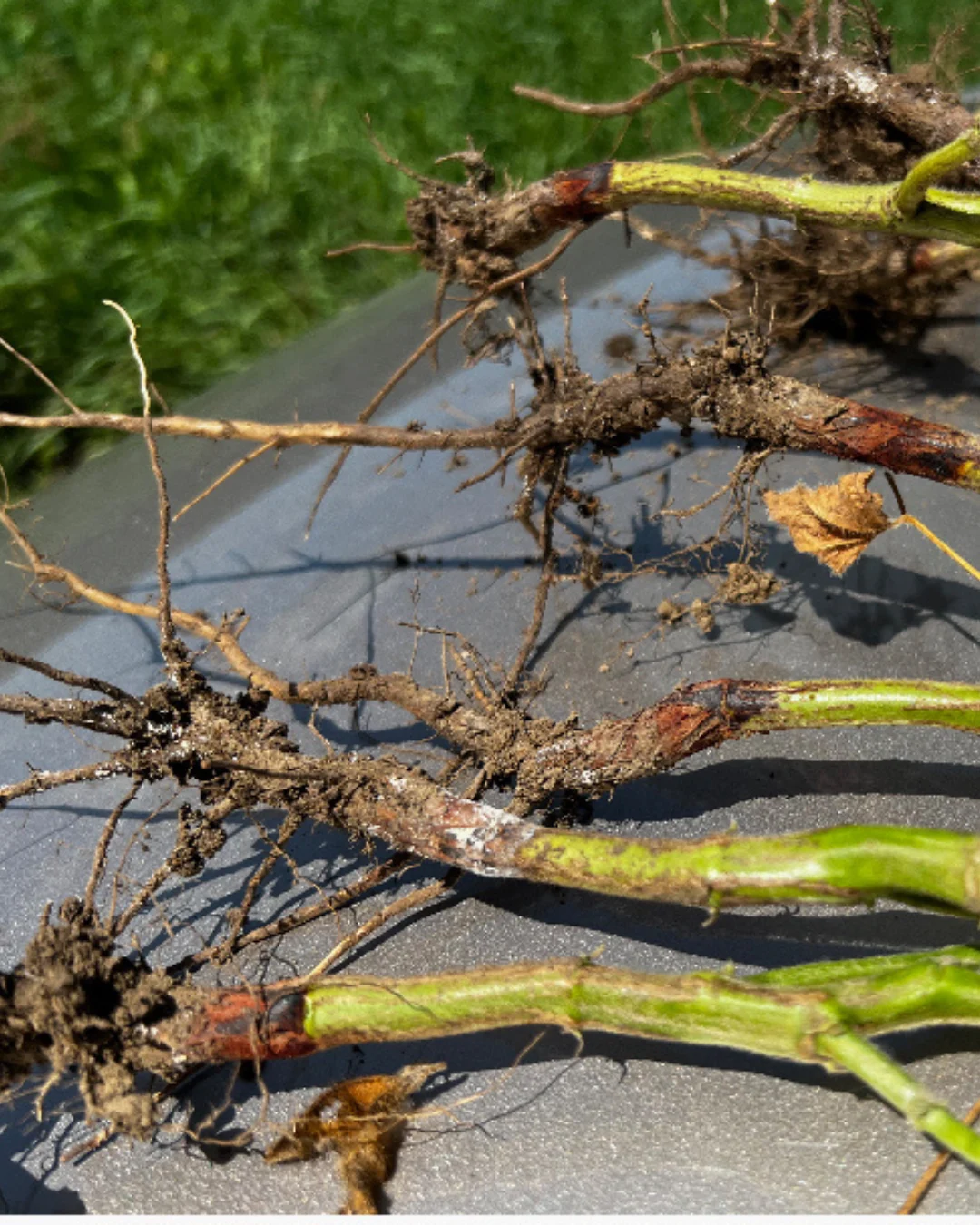
Soybean stems with red crown rot at their base.
Photo Credit: Stephanie Porter, ISA
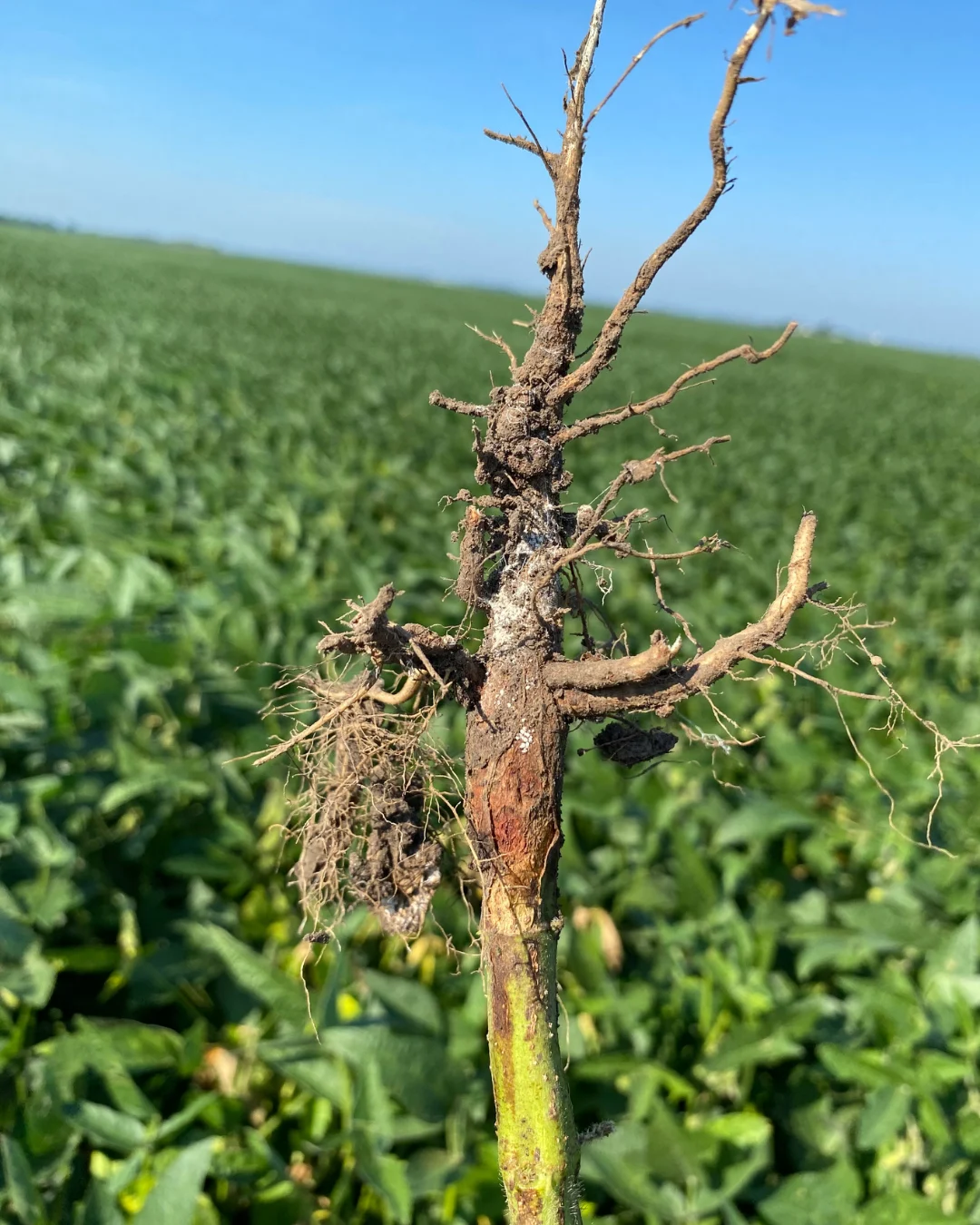
Soybean stem with red crown rot at its base.
Photo Credit: Stephanie Porter, ISA



 and then
FIND US ON