
Double-crop soybeans following winter wheat can be a profitable addition to the crop rotation in Illinois, but success depends on getting the most out of a significantly shortened growing season. Every day of delay after optimum planting windows can directly reduce yields by 0.5 to 1.0 bushel per acre. Consider these eight critical management factors to capture top-end yields.
- Plant as early as possible
Planting as early as possible is the single most critical factor for driving higher yield. To pull the soybean planting date forward, the preceding wheat crop must be harvested at the earliest opportunity. If you want to harvest wheat grain dry, your management plan must start a year ahead of time by selecting a high-yielding wheat variety with an early maturity rating for your area. Alternatively, using stripper heads or harvesting winter wheat early at a higher moisture content (18% to 20%) and then drying the grain can give growers a crucial 5-to 10-day head start on soybean planting.
- Manage wheat straw residue
Uneven or heavy straw distribution can prevent good seed-to-soil contact and cause “hair-pinning” in the seed trench. Combine harvesters should chop and spread straw completely evenly across the full width of the header. Leaving a taller standing stubble (8 to 12 inches) encourages soybean plants to set their lowest pods higher off the ground, facilitating an easier harvest.
- Select the right variety of soybean
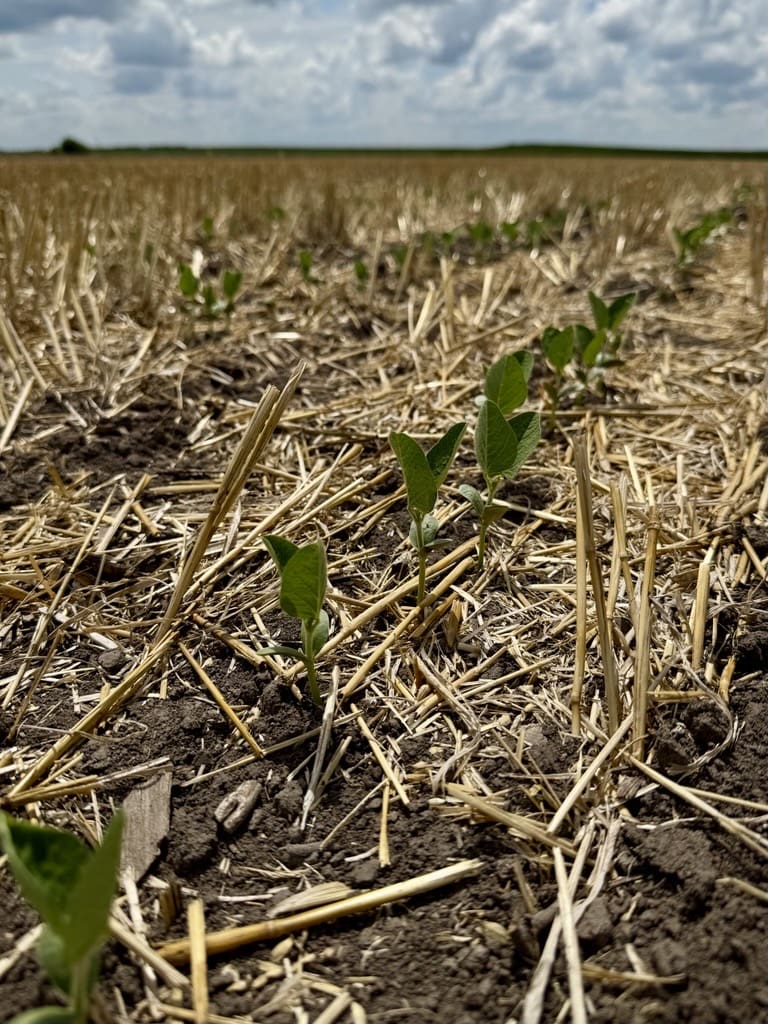
Double crop soybeans. Photo by Darby Danzl, Illinois Soybean Association
Always start with a high-yielding variety with strong genetic potential. From there, growers may instinctively lean toward earlier varieties to reduce risk, but selecting the longest maturity group that can safely mature before the first freeze will normally deliver better yield results. A variety with a longer relative maturity group utilizes the full remaining season, putting on more nodes and leaf mass before flowering, which helps drive yield performance.
- Seed at higher rates
Double-crop soybeans have less time for vegetative growth, meaning they end up shorter and with fewer nodes and pods per plant. To compensate for smaller individual plants, you must increase target populations by 15% to 30% compared to full-season fields. Target a final stand of 180,000 to 200,000+ plants per acre to maximize pod density across the field.
- Plant in narrow rows
Narrowing row width speeds up canopy closure, suppresses weed growth, enables capture of the most available sunlight early, and drives photosynthesis during pod filling. Planting in 7.5-inch or 15-inch rows is preferred to 30-inch rows, which fail to shade the ground quickly enough in a shortened season.
- Conserve soil moisture
Winter wheat often depletes soil moisture levels. No-till planting directly into the grain stubble preserves critical soil moisture and saves time. Row-crop planters generally achieve better downforce to drive through hard, dry soil and ensure consistent placement into adequate moisture. If soil conditions remain dry past the safe planting window, waiting to plant ahead of rain or even abandoning the double crop plan, may be the more profitable choice.
- Manage soil fertility
Double-crop soybeans are often treated as a minimum-input crop, but they remove high levels of nutrients from the soil—particularly potassium. When evaluating fertility, growers must account for the dual nutrient removal of both the wheat grain and the subsequent soybean crop to prevent sharp drops in soil test levels. Fertility management becomes even more important when wheat straw is also removed.
- Scout for weeds and other pests
Late-planted soybeans act as a magnet for pests because they remain lush and green while surrounding full-season fields mature and turn brown. Insect pressure from stinkbugs, grasshoppers and pod-feeders can escalate aggressively in late summer. Regular scouting and targeted applications of insecticides or fungicides at the R3 growth stage help protect late-season yield potential. Continue to scout and consider the return on additional input investments as the season unfolds – actively manage for profit.
For tailored insight and research on double-crop beans, consult University of Illinois Extension resources.
References:
Double‑crop soybeans. Illinois Agronomy. https://ilagronomy.info/publications/crop-management/double-crop-soybeans/
Wheat and double‑crop soybeans. University of Illinois farmdoc. https://farmdoc.illinois.edu/field-crop-production/wheat-and-double-crop-soybeans.html
ISA Double‑Crop Soybean Production Guide. Illinois Soybean Association. Double‑Crop Soybean Production Guide. 2019. https://www.soybeanresearchdata.com/files/progress5/53700_2019_ISA_Double_Crop_Guide_FINAL_082919.pdf
Double‑cropping soybeans. University of Missouri Extension. Double‑cropping soybeans. https://extension.missouri.edu/media/wysiwyg/Extensiondata/Pub/pdf/agguides/crops/g04953.pdf
Double‑crop soybean production. University of Kentucky Cooperative Extension Service. AGR‑261: Double‑crop soybean production. https://publications.mgcafe.uky.edu/sites/publications.ca.uky.edu/files/AGR261.pdf

Tim Laatsch, CCA, is owner and president of Field Hawk Ag Research LLC, a company providing contract research services to the agricultural industry. He has held a variety of roles across the agricultural sector, including eight years leading agronomy in North America for Koch Agronomic Services, three years in technical agronomy with GROWMARK, 12 years in environmental management and executive operations leadership with The Maschhoffs, and three years with University of Illinois Extension. Through these roles, Laatsch has developed a holistic perspective on agriculture as a seasoned business leader, people developer, skilled communicator and sustainability advocate. His academic training is in soil science and microbiology, earning a bachelor’s degree from Southern Illinois University Carbondale and a master’s degree from Michigan State University. He is a graduate of the Illinois Agricultural Leadership Foundation Class of 2010 and recently served three years on the Illinois Nutrient Research and Education Council. Laatsch and his wife, Jane, reside in rural Altamont adjacent to the Laatsch Centennial Farm. Fourth-generation farmers who both grew up in agriculture, they took over the family operation 10 years ago. They enjoy traveling, hiking, biking and spending time with their two adult children, son-in-law and four grandchildren.


 and then
FIND US ON