As pest pressures continue to shift across the Midwest, Illinois researchers are closely monitoring two insects raising concerns in neighboring states: soybean gall midge and dectes stem borer. Dectes stem borer is an established pest that appears to be growing in importance in Illinois, while soybean gall midge remains a potential invasive species that has not yet reached the state. A multi-year effort funded by the Illinois Soybean Checkoff is helping farmers understand where these pests stand today and what to watch for heading into 2026.
Soybean Gall Midge: Still No Signs in Illinois
Soybean gall midge has still not been detected in Illinois after three years of statewide monitoring. In 2025, Kelly Estes, University of Illinois Agricultural Pest Survey Coordinator, and her team surveyed 200 soybean fields across 45 counties. Sweep-net samples were collected to monitor adult dectes stem borers and other soybean pests. Because soybean gall midge adults are extremely small and not typically captured in sweep nets, detection efforts rely on examining soybean plants, particularly along field edges where early signs of injury are most likely to appear. To date, no soybean gall midge has been found in Illinois.
Dectes Stem Borer: A Growing, Localized Concern
Meanwhile, Dr. Nick Seiter's lab at the University of Illinois focused on larval populations of dectes stem borer. From 2021 to 2023, they surveyed no-till fields across the state, especially in southern Illinois, to identify where larvae were most prevalent. In 2025, they narrowed their focus to two locations in southern Illinois with known infestations, sampling soybean residue throughout the summer to track the development of overwintered larvae.
Dectes stem borer populations were consistently detected, particularly in south-central Illinois, where no-till and reduced-till soybean production are common. These systems create ideal conditions for the pest because undisturbed crop residue provides excellent overwintering habitat for larvae. Adult borers were first detected in late June (June 25 near Perry and June 26 near Ewing) and remained active through mid-July. This timing is crucial as farmers plan their scouting and management strategies.
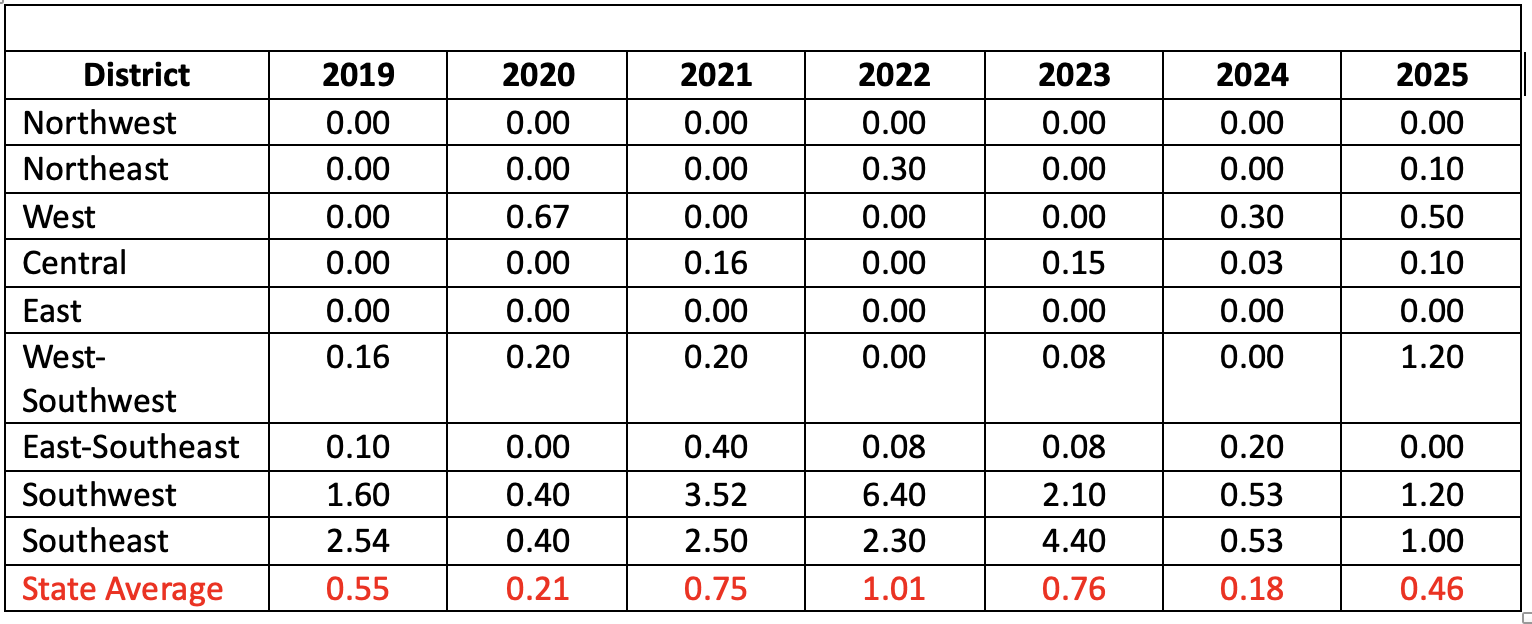
Dectes Stem Borer Counts By Year (Provided by Kelly Estes)
Farmers in counties like Marion, Franklin, Jefferson and Washington should be particularly vigilant. Fields with more than 30% of plants infested by dectes stem borer larvae should be prioritized for harvest to reduce the risk of lodging, which occurs when larvae girdle stems in preparation for overwintering.
Scouting for dectes stem borer should begin in late July or August, after adults have emerged and laid eggs. Fields in or near no-till production zones are at the highest risk. Understanding the timing of adult emergence and larval development can help farmers make informed decisions about harvest scheduling and pest management.
A multi-state project funded by NCSRP is currently investigating the potential for chemical control of dectes stem borer, as well as the yield impacts of stem tunneling and lodging. While tunneling itself may not significantly reduce yields, lodging can lead to harvest losses and operational challenges.
This research underscores the importance of proactive monitoring and region-specific management strategies. As pest dynamics continue to evolve, Illinois soybean growers will benefit from staying informed and engaged with ongoing research efforts.
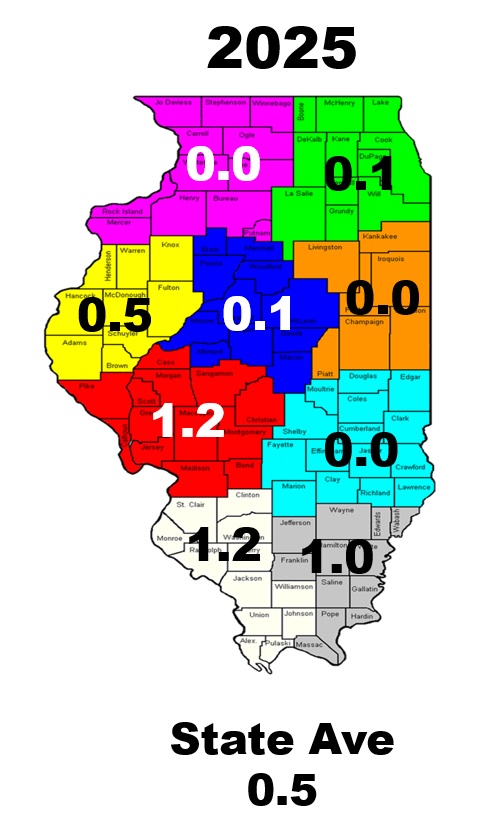
Provided by Kelly Estes and Nick Seiter
As Outreach Agronomist for the Illinois Soybean Association (ISA), Stephanie supports research efforts and helps communicate both in-field and edge-of-field research and validation studies to Illinois 43,000 soybean farmers. She also helps lead the demonstration and adoption of conservation agriculture practices and raises awareness of best management and continuous improvement practices for conservation agriculture in Illinois.
Stephanie has 23 years of experience that consists of agronomy, conservation, horticulture, plant diagnostics, and education. She has her bachelor’s in crop science and master’s in plant pathology from the University of Illinois. Stephanie is a Certified Crop Advisor and was named the 2018 Illinois Certified Crop Adviser Master Soybean Advisor. She also has experience with corn and soybean pathology research, crop scouting, soil testing, as well as crop consulting. Previously, she utilized her diagnostic training and collaborated with University of Illinois departmental Extension Specialists to diagnose plant health problems and prepare written responses describing the diagnosis and management recommendations as the University of Illinois Plant Clinic.
 and then
FIND US ON