
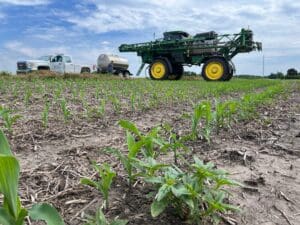
Picture Credit: Brandon Hall, CCA, West Central FS and IL Soy Envoy.
In my seed sale agronomist glory days, I remember helping many to learn a new way to spray once LibertyLink soybeans began making their debut on the market after glyphosate resistance began to run rampant. Glufosinate is a contact herbicide that depends on active plant metabolism, good coverage, and favorable environmental conditions. The issue now is that glufosinate resistance is now real and confirmed in Illinois. So, we can’t assume glufosinate failure is just “bad luck”. If you see poor control, it may not just be weather or coverage issue anymore. You may need to assume that some fields could contain resistant escapes.
While glufosinate performance is known to depend heavily on environmental conditions and application practices, it’s not always clear whether those same “ideal” conditions are enough to control tougher or potentially resistant populations. A recent University of Illinois study funded by the Illinois Checkoff takes a closer look at how glufosinate performs under different scenarios to help farmers better understand how to maintain effective waterhemp control.
Here is a slightly updated glufosinate spray decision checklist based on this study:
- Temperature
You may get better control of susceptible waterhemp with glufosinate, but if the waterhemp is resistant, you will get better control in cooler temperatures. This is likely because resistant plants break down glufosinate faster in heat. If you suspect glufosinate resistance on your farm, avoid spraying in extreme heat and aim for more moderate temperatures to improve performance.
- Time
The best time to apply glufosinate is midday or late morning to early afternoon to gain better light activation and higher plant activity. It is best to avoid applications in the evening or night as well as early morning if the plants are not actively growing yet.
- Sunlight
Glufosinate works best when application takes place on a day with full sunlight and minimal cloud cover.
- Humidity
When spraying glufosinate, moderate to high humidity is preferred. If possible, avoid spraying during very dry air conditions.
- Coverage
As most have learned, coverage is critical when it comes to spraying glufosinate. You kill what you hit. The carrier volume should be 15 to 20 GPA minimum and higher if the soybean canopy is dense or control is slipping. Optimize nozzle selection and go for medium droplets size to balance coverage.
- Don’t Run Glufosinate Alone
One of the most important strategic takeaways from this U of I glufosinate study is that glufosinate should not be used as a standalone post program anymore. This is because if you use it alone, you can speed resistance, make inconsistent control worse, and leave survivors. It is recommended that you layer glufosinate with PRE and POST residuals. Use tank-mix partners where appropriate and always integrate non-chemical weed management.
This study now shifts the midset from “if glufosinate didn’t work, conditions were bad” to “if glufosinate didn’t work, it could be conditions and resistance interacting”. Glufosinate can still control waterhemp effectively, but performance now depends on getting the conditions right and managing resistance. Spray small weeds at midday in bright sunlight with moderate temperatures and good humidity and avoid extreme heat or late-day applications. Ensure strong coverage and don’t rely on glufosinate alone—use it as part of a broader program with residuals and additional herbicide modes of action to reduce escapes and slow resistance.
Resources:
Improving Glufosinate Performance for Waterhemp Control – Field Advisor
Understanding Inconsistent Performance of Glufosinate for Waterhemp Control – Field Advisor
Illinois Research Targets Why Glufosinate is Losing Effectiveness on Waterhemp – Field Advisor

As Outreach Agronomist for the Illinois Soybean Association (ISA), Stephanie supports research efforts and helps communicate both in-field and edge-of-field research and validation studies to Illinois 43,000 soybean farmers. She also helps lead the demonstration and adoption of conservation agriculture practices and raises awareness of best management and continuous improvement practices for conservation agriculture in Illinois.
Stephanie has 23 years of experience that consists of agronomy, conservation, horticulture, plant diagnostics, and education. She has her bachelor’s in crop science and master’s in plant pathology from the University of Illinois. Stephanie is a Certified Crop Advisor and was named the 2018 Illinois Certified Crop Adviser Master Soybean Advisor. She also has experience with corn and soybean pathology research, crop scouting, soil testing, as well as crop consulting. Previously, she utilized her diagnostic training and collaborated with University of Illinois departmental Extension Specialists to diagnose plant health problems and prepare written responses describing the diagnosis and management recommendations as the University of Illinois Plant Clinic.


 and then
FIND US ON