
The sight of crop fields brightly adorned with blooming weeds in April and May is becoming an increasingly common occurrence in Illinois. While this is not a new observation for no-till fields, particularly in Southern Illinois, winter annual weeds are becoming increasingly common due to a trend toward reduced tillage as well as unpredictable fall and spring weather patterns that may delay planned tillage operations or herbicide applications. While winter annual weed species do not directly compete with the crop during winter months, there are several factors to consider that may make fall control of winter annuals a beneficial input for your farming operation.
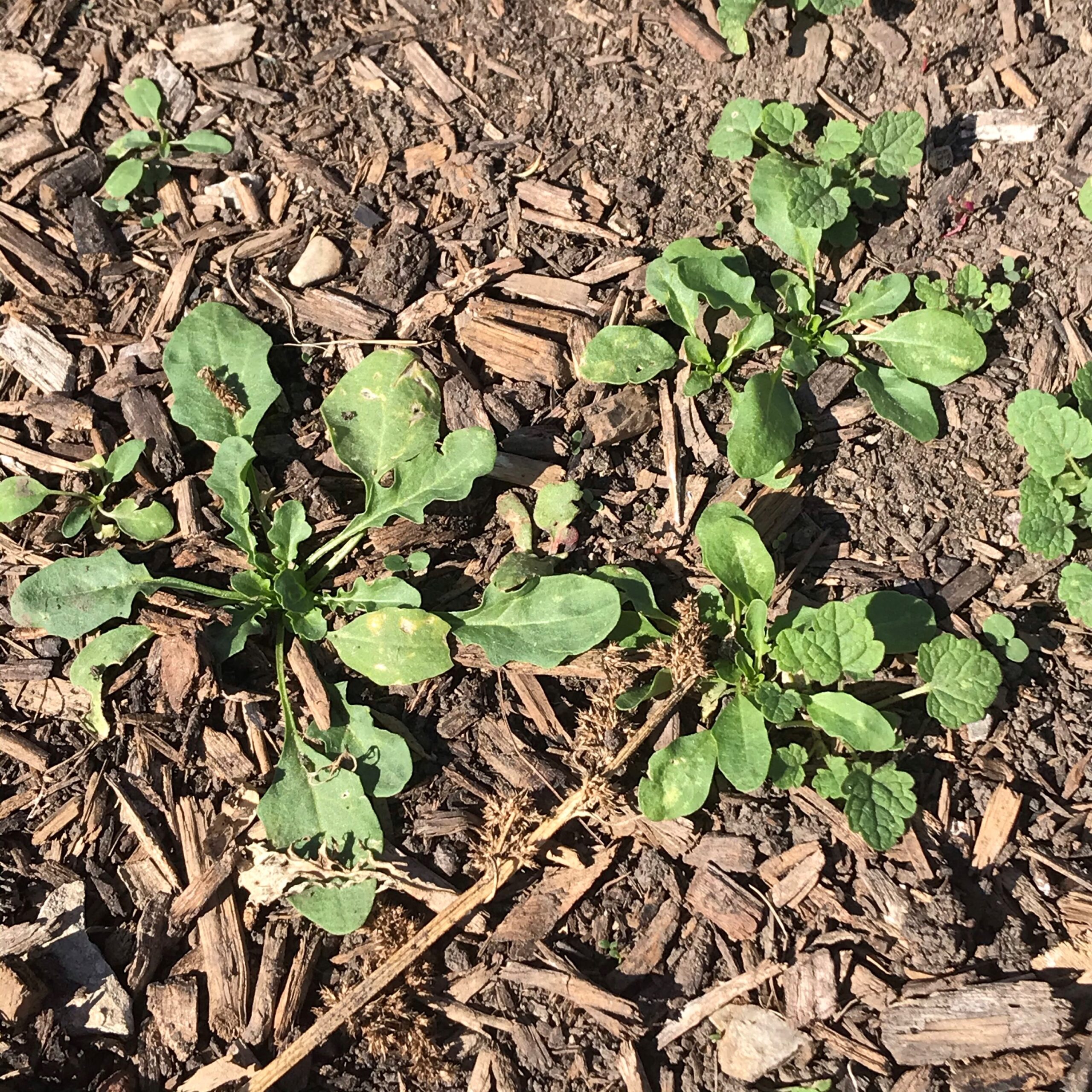 What are winter annual weeds?
 Winter annuals weeds germinate from early to late fall, overwinter in the vegetative stage, and then flower and produce seed from spring through early summer. Common winter annual weed species in Illinois include common chickweed (Stellaria media), henbit (Lamium amplexicaule), purple deadnettle (Lamium purpureum), cressleaf groundsel (Packera glabella) also known as butterweed, shepherd’s purse (Capsella bursa-pastoris), field pennycress (Thlaspi arvense), and various types of speedwell (Veronica).
Although not strictly a winter annual, marestail, also known as horseweed (Conyza canadensis), can emerge in the fall. Marestail plants that overwinter may be more difficult to control with herbicides in the spring due to physiological adaptations that occur for marestail and other winter annuals for enduring freezing temperatures and low relative humidity during the winter. Two valuable online resources for identifying winter annual weeds on your farm include Early Spring Weeds of No-Till Crop Production and Identification of Winter Annual Weeds.
Why should you consider fall herbicide applications to control winter annual weeds?
- Improved weed control: While winter annuals can also be controlled with herbicides in the early spring, fall control can be more effective due to smaller weed size and weeds that have not yet acclimated to winter weather. Winter annuals typically have green leaf tissue in the winter, and they develop a thick, waxy cuticle on the leaf surface to limit desiccation from cold winter winds. This thicker cuticle can limit uptake of applied herbicides or require higher rates of oil-based adjuvants.
- Reduced competition: In a no-till cropping system, fall weed control can reduce early-season competition of weeds with the emerging crop. Weeds compete with the crop for sunlight, water and nutrients.
- Spring herbicide application flexibility: Going into spring with a clean field may provide greater flexibility in spring herbicide decisions or application timing. There may not be a need for a pre-plant burndown application or chemistry with activity on emerged weeds applied at planting.
- Improved field conditions and insect control: Fields with a thick cover of winter annuals will likely dry slower in the spring. This can delay timely planting in no-till management systems, or delay tillage operations prior to planting. Additionally, weed presence in early spring can provide habitat for pests. These include cutworm species as well as slugs.
What are the herbicide options for fall applications?
Many herbicide products are labeled for burndown applications. When choosing herbicide products for fall, consider the target weeds (broadleaves versus grasses), residual activity versus activity on emerged weeds, and crop to be planted the following spring. Intended crop rotation is critical when selecting herbicides with residual activity. For example, simazine is commonly used for fall burndown applications, but it should only be applied to acres that will be planted to corn the following spring. Here are a few common options for fall burndown applications for acres to be planted to soybean:
- 2,4-D: This active ingredient is commonly used as a cost-effective foundation for fall herbicide programs. Products combining both 2,4-D and dicamba are also used for fall burndown applications. Keep in mind that growth regulator herbicides are more active when weeds are actively growing, so applications when nighttime temperatures are above freezing, and daytime temperatures are approaching at least 50 degrees Fahrenheit, will produce best results.
- Glyphosate: Glyphosate should not be used by itself due to concerns about weed herbicide resistance, and the presence of species like marestail that have glyphosate resistant populations. Glyphosate is a required addition when grass weeds are present since 2,4-D and dicamba are only effective on broadleaves. Also, although glyphosate tends to work slowly even in ideal conditions, it does help improve the efficacy of fall burndown applications later in the fall when temperatures are decreasing and activity of 2,4-D and dicamba is lagging.
- Residual chemistry: Products containing ALS and PPO active ingredients are sometimes used for fall burndown applications to provide activity on emerged weeds as well as residual activity. The length of residual activity can vary greatly between active ingredients and can limit crop rotation options, so pay close attention to label restrictions. Metribuzin is another active with residual activity and is a great option due to flexibility to plant either corn or soybean the following spring.
Final thoughts
Fall burndown applications will not be appropriate for every situation. For example, if you are chiseling corn stalks in the fall, do not have a history of heavy winter annual weed pressure, or plan to clean-till ahead of planting soybeans in 2021, fall weed control will have limited value. For those in no-till or reduced tillage management, however, controlling weeds this fall is the first step to a comprehensive weed management program to support optimized soybean productivity and profitability in 2021.

Jason Haegele is the region agronomist for WinField United in Illinois and leads WinField United’s agronomy services team for the eastern United States. Employed by WinField United for four years, Haegele was previously a research scientist with DuPont Pioneer for two years. Haegele holds a bachelor’s degree in agronomy and ag engineering from Iowa State University, a master’s in crop production and physiology also from Iowa State, and a Ph.D. in crop sciences from the University of Illinois.


 and then
FIND US ON