
Illinois Soybean Association Soy Envoy Blog | June 2026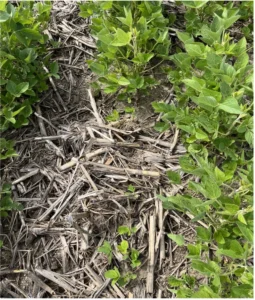
By: Brandon Hall, CCA, CCS – West Central FS – Wataga, Illinois
—
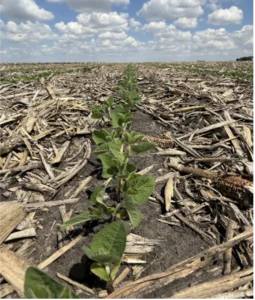
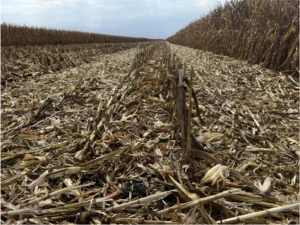
As planting season progresses across Illinois, one of the most common concerns I hear from growers revolves around residue management. Whether it’s the stubble from an 80+ bushel soybean crop or the corn stalks left behind from a 270+ bushel corn crop, higher yields bring a new challenge: managing the increasing amount of crop residue while maintaining a clean, productive seedbed. Today’s growers are focused on maximizing productivity while simultaneously improving soil health. The question becomes: How can we build soil health while maintaining a clean seedbed? The answer lies in understanding that residue management is not a single practice, it’s a season-long systematic strategy that begins at harvest and continues through planting.
Residue Management Starts at Harvest
Many associate residue management with fall tillage or fertilizer applications, but in reality, effective residue management begins with the combine. When setting up a combine, we often focus on grain loss and harvesting efficiency. However, it is equally important to evaluate residue size, distribution and spread pattern across the entire harvest width.
Properly distributed residue creates a more uniform environment for planting and crop emergence the following spring. Residue that is chopped into smaller pieces provides more surface area for microbial activity, allowing it to break down more efficiently. Uneven distribution, on the other hand, can create challenges ranging from cold, wet soils to planter performance issues. For no-till growers especially, combine setup may be the single most important residue management pass made all year. A few extra minutes spent checking residue spread and sizing during harvest can pay dividends the following spring.
Using Tillage as a Residue Management Tool
Tillage remains a valuable tool for residue management, although its role has evolved as growers continue adopting conservation-focused systems. Many Illinois farmers have transitioned to practices such as vertical tillage and strip-till to balance residue management with soil conservation goals.
- Vertical tillage can help size residue into smaller pieces, accelerating decomposition while minimizing soil disturbance compared to conventional tillage systems. It can also improve residue distribution when the combine spread patterns leave uneven concentrations across the field.
- Strip-till continues to gain popularity throughout Illinois because it accomplishes multiple objectives in a single pass. Growers can place fertility precisely within the strip while creating a clean seedbed for spring planting.
In my observations over the past several years, strip-till systems often provide noticeably cleaner planting zones. Residue levels within the strip are reduced, and soil temperatures are commonly four to six degrees warmer at planting compared to surrounding areas. These conditions can improve planter performance and promote more uniform crop emergence.
Leveraging Biology to Accelerate Residue Breakdown
Another emerging tool in residue management is the use of biological products. The biological marketplace continues to grow rapidly, and it can sometimes feel like the “Wild West” of agriculture. While not every product delivers the same results, there are biological tools available that can provide real value when properly evaluated and implemented. Many of these products are designed to stimulate and feed the microbial communities already present in our soils. Others are intended to increase microbial populations and activity. Simply put, microbes are the workforce, and crop residue is the job. When we create an environment that supports microbial activity and provides the energy sources these organisms need to thrive, they respond by building larger, more active populations. Those populations work continuously to break down crop residue and recycle nutrients back into the soil system.
Over the past several years, I have conducted on-farm trials evaluating various biological products for residue management. My goal has been to identify products that not only improve residue breakdown but also provide a positive return on investment for growers. The results have shown that some products can effectively achieve both objectives. However, biological performance is often influenced by soil type, environmental conditions, management practices and cropping systems. Because every operation is different, my recommendation is simple: test products on your own farm, evaluate the results and determine which solutions work best within your management system.
Building Soil Health Without Sacrificing Planting Conditions
As yields continue to increase, residue management will remain a critical component of successful crop production. The good news is that growers do not have to choose between soil health and a clean seedbed. By focusing on combine management, utilizing conservation-minded tillage practices where appropriate and incorporating biological tools that support residue decomposition, farmers can achieve both goals. Effective residue management is not about eliminating residue; it is about managing it strategically so that the benefits of soil protection, moisture conservation and soil health are maintained, while minimizing the challenges that excessive residue can create during planting.
In other words, it truly is possible to have your cake and eat it too.
Citations
Bayer Crop Science. Research and agronomic guidance on crop residue production and management in high-yield corn systems.
Illinois Soybean Association. Soil health and conservation management resources.
University of Illinois Extension. Residue management, strip-till, and conservation tillage best management practices.
USDA Natural Resources Conservation Service (NRCS). Soil health principles and residue management recommendations.
North Central Sustainable Agriculture Research and Education (SARE). Managing crop residues for soil health and productivity.

Brandon Hall serves as the location operations manager at West Central FS in Wataga, Illinois, a role he has held for more than 11 years. He earned his Certified Crop Adviser certification in 2018 and GROWMARK Certified Crop Specialist designation in 2025. He shares his agronomic experiences on social media as @ilsoilnerd on X and Instagram. Hall earned an associate degree from Black Hawk College East Campus and a bachelor’s degree in soil and crop science from the University of Wisconsin Platteville. He serves as a director on the Knox County Farm Bureau Board, president of the Williamsfield FFA Alumni and Friends, board member of the Knox County Cattlemen’s Association and vice chair of the Black Hawk College East Foundation. He was named the 2023 Illinois Farm Bureau CCA of the Year and received the 2025 Illinois Soybean Association Dave Rahe Excellence in Soils Consulting Award. He lives in Williamsfield, Illinois, with his wife and three children.


 and then
FIND US ON