This article was originally published on the Soybean Research & Information Network on April 6, 2026.
By Carol Brown
Soil health is a fundamental component in farming. Crops don’t grow to their full potential in ailing soils. Farmers can employ conservation practices to improve soil health including reduced tillage and cover crops. But when do these conservation practices translate to results in crop performance? There is much buzz about the profitability of soil health. Theoretically, a healthier soil should have greater yield for the same inputs, or achieve similar yields at lower inputs, thus increasing the return-on-investment.
The Field Advisor program, funded by the Illinois Soy Checkoff, hosted two webinars with guest presenter Andrew Margenot who discussed soil health. Margenot, a soil scientist and associate professor at the University of Illinois Urbana-Champaign, has been researching soil health and indicators of improvement through a research project supported by the Illinois Soy Checkoff.
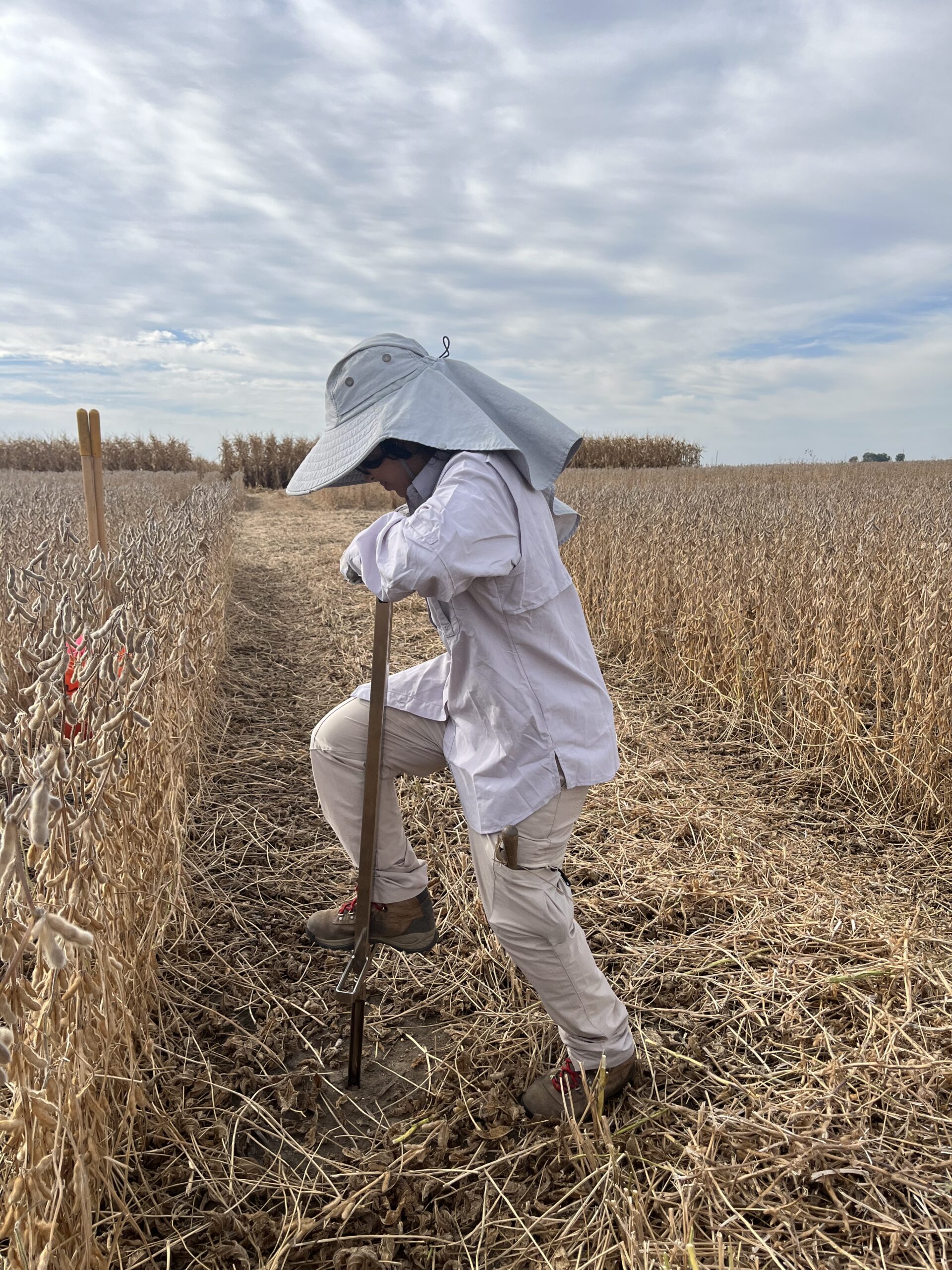
Technician Grecia Romero collects a soil sample during Fall 2025 at field site in Southern Illinois.
The first webinar, “Soil Health Sounds Great — But is it Paying Yet?” focused on whether soil health improvement could be assessed after early adoption of conservation management. Margenot discussed what common soil health indicators are and whether testing soils for these indicators provides actionable insights for farmers. The webinar included data presented by Heidi Allen Asensio, a doctoral student at the University.
The second webinar featured Margenot and John Pike discussing, “Cover Crops and Soil Health for Better Crop Fertility Decisions.” Pike, an independent research agronomist and consultant, offered a field-level perspective of Margenot’s scientific review on the extent to which cover crops may impact soil fertility — a major theme of more than 150 questions submitted by attendees of the first webinar.
Soil Health Trials
Margenot is entering the final season of a four-year benchmarking project that focuses on the interrelations of soil health, carbon credits, yields, profitability and water quality within a cropping system. The project has sites on the University’s campus, at Monmouth in western Illinois, and a southern site at Ewing, representing prairie and timber soils of the northern and southern soybean belt. Each site has trials of cereal rye cover crop with chisel plow and no-till, in crop rotations of corn-soybean and corn-double crop wheat-soybean, each in staggered rotations, for a total of 200 plots. Some measurements, such as greenhouse gas emissions, were taken weekly on all the plots, and other measurements are seasonal including soil health and fertility, and yield.
“We all know soil health outcomes take time, especially conservation practice-driven soil health,” Margenot comments. “The evidence supports this being correct. We’ve seen that within six, eight and 10 years of no-till and cover cropping, it is very likely to elicit a positive soil health change. The question is what happens in the short-term: Are there growing pains? What can the soybean grower expect to see within one or two rotations of conservation practice adoption?”
The webinar included soil health indicator data taken at the two-year mark of the project. Soil type carries a lot of weight in whether these conservation practices can make a difference after a couple years, Margenot says. There is a point in which soil shifts metabolism of the system and where soil health indicators begin to respond to a practice in yield and profitability. In general, high organic matter soils responded less, or not at all, than lower organic matter soils to conservation practices in terms of soil health indicators.
Of the different soil health tests available, Margenot focused on respiration measurements in the webinar. He offered pros and cons of using a respiration test along with results for each site.
“The most responsive indicator is soil respiration, or CO2 release, which is the oldest measurement that is a recognized soil health indicator,” he comments. “In some cases, there was no response in the first two years. But differences appear when the samples were taken between spring and fall, as well the crop rotation phase. Within the first two years, wheat double-cropping with soybean appeared to have the greatest and positive effect on soil respiration — more so than cover crops.”
Cover Crops and Soil Health
The second webinar focused on how cover crops affect soil health, especially in the short-term. Margenot and co-presenter John Pike tag-teamed to offer research results and real-world applications. The webinar also addressed questions that were asked from participants after the first webinar.
“We’re good at getting cover crops on the ground,” Pike says. “But farmers don’t have a lot of information about the management and transition to cover crops in a corn-soybean system, which created yield drags. There are a lot of things that can help us sidestep the challenges that are common with cover crops.”
The first step Pike recommends is not to begin cover crops ahead of corn. Earlier research he conducted between 2015 and 2021 in Hamilton County, showed steady yields in soybeans and improved yields in corn, rather than a yield drag, when cover crops were begun before soybeans. He compared cover crop adoption to when farmers transitioned to no-till and noted there is a period of adjustment farmers need to be cognizant of when transitioning to these conservation systems.
Margenot discussed how soil organic matter affects crop yield and how cover crop species other than cereal rye may affect soil health. Clovers and vetches have the highest potential for nitrogen fixation, but he warns biological nitrogen fixation doesn’t begin until soils are warmed, later in the season. Early legume cover crop termination may not have much net nitrogen to release.
Pike reminded webinar participants of the many benefits that cover crops can bring to the field including weed suppression, improved water infiltration, loosening of the soil to allow the corn and soybean roots to function better, and improved biological soil activity.
Lastly, Margenot discussed the potential benefits of arbuscular mycorrhiza fungi, or AMF, for soil health. AMF has benefits that are good for phosphorus and nitrogen and he discussed ways that AMF could be increased. How much these benefits are, such as pounds per acre, and how well they can be managed, remains a topic for future research.
All the Field Advisor webinars, including these two, are recorded and available to watch on the Field Advisor’s YouTube channel. Continuing education credit is available as well. Growers can sign up for their newsletter on the Field Advisor website, which promotes events and webinars like these.
Additional Resources
Learning From the Integration of Soil Health, Water Quality and Climate-Smart Agriculture – SRIN article
Cereal Rye Cover Crop Termination Timing Effects on Soybean Yield Across the Midwest – SRIN article
Illinois Soybean Association’s Field Advisor – website
Meet the Researcher: Andrew Margenot University profile | Soils Lab
The Soybean Research & Information Network (SRIN) is funded by the Soy Checkoff and the North Central Soybean Research Program. For more information about soybean research, visit the National Soybean Checkoff Research Database: https://www.soybeanresearchdata.com/Project.aspx?id=55755 and https://www.soybeanresearchdata.com/Project.aspx?id=55780.

The Soybean Research & Information Network (SRIN) is supported by the United Soybean Board and the North Central Soybean Research Program. Agronomic research across a wide variety of topics and geographies funded by state and national soybean checkoff prorams is collected by SRIN at https://soybeanresearchinfo.com/.

 and then
FIND US ON