
Many Illinois soybeans are firmly established in the early vegetative stages, with 44% of soybeans emerged across the state as of May 17 (USDA NASS). So, what exactly is happening with the soybean plant at these early growth stages? Let’s dive in!
Vegetative Emergence (VE): The vegetative emergence stage occurs when the cotyledons are above the soil surface. This means the growing point is now above the soil and therefore can be impacted by stressors like cold injury and deer browsing. For 7 to 10 days, the cotyledons will serve as the primary photosynthetic source for the plant. It is generally too early to start stand assessments at this growth stage.
Vegetative Cotyledon (VC): At this stage, the one and only set of unifoliate leaves on the plant are unfolded. These leaves, along with the cotyledons, are the early photosynthesis energy for the plant. If the unifoliate leaves are injured, but the cotyledonary node remains, the plant can still recover by sending axillary branches from the cotyledonary node.
Vegetative Stages 1-3 (V1-V3): In the numbered vegetative growth stages, the 1st, 2nd, 3rd, etc. trifoliate leaves have unfolded. The V1/V2 growth stages are optimal for accessing the need to replant soybeans. This is also the time when nodules start to form on the soybean roots to facilitate nitrogen-fixation. The V2/V3 growth stage is a good time to check for active nitrogen-fixation which will be obvious if you cut through the soybean nodule and the inside is pink.
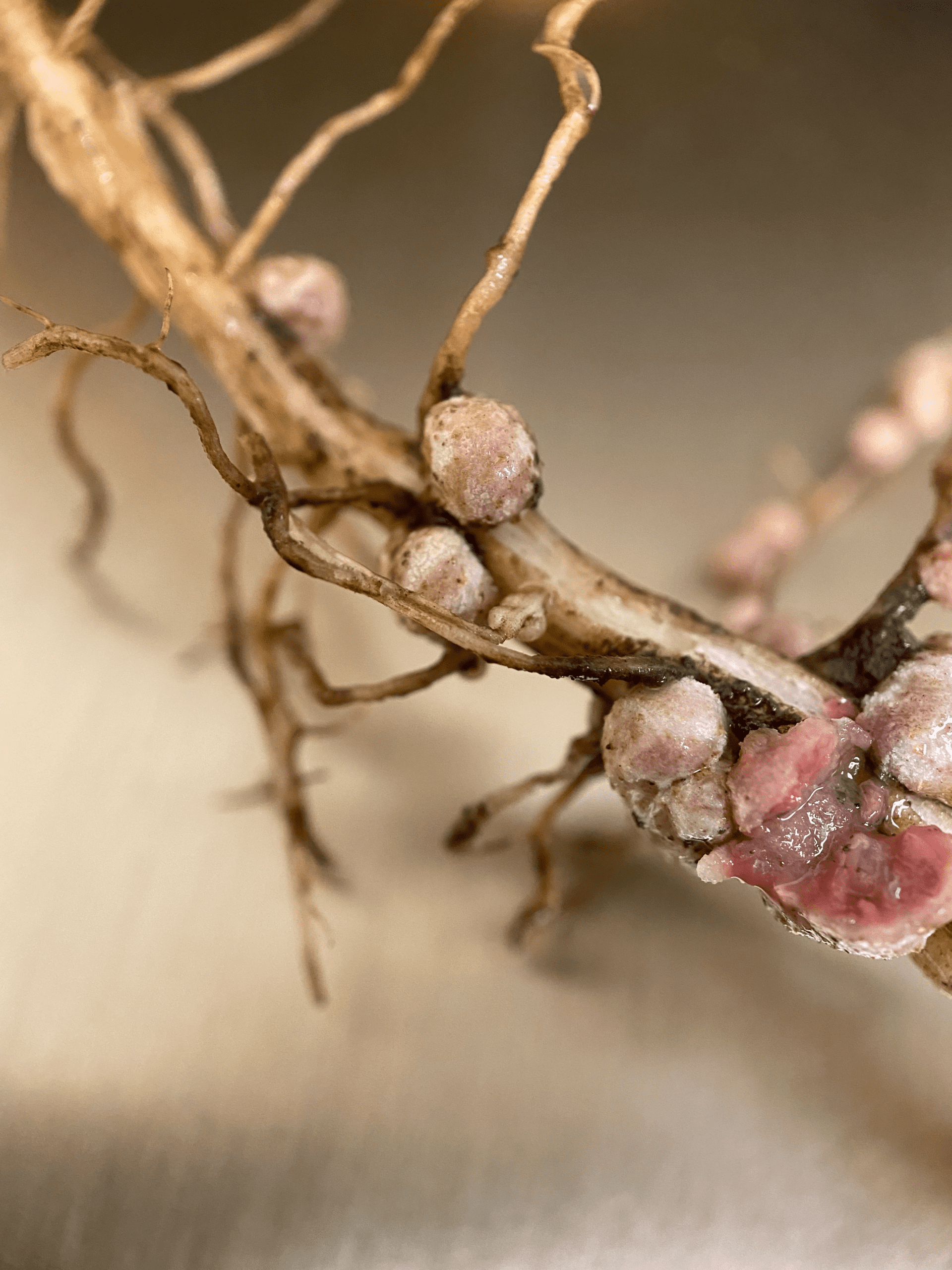
Soybean nodule. Photo provided by Stephanie Porter, Illinois Soybean Association
On average, each of these stages occur for about five days with a range of 3 to 10 days! With this spring being cooler than normal in much of Illinois, it is likely taking soybeans a bit longer to move from one early growth stage to the next. While the early growth stages might seem boring, early season vegetative growth helps build the engine for supporting pod and seed development later in the season!
References
Iowa State University. Stages of Soybean Development
Moseley et al., The soybean growth cycle: Important Risks and Management Strategies
University of Arkansas and University of Wisconsin Madison. A Visual Guide to Soybean Growth Stages
Science for Success. The Soybean Growth Cycle: Important Risks, Management, and Misconceptions

Rachel Vann is a Cropping Systems Agronomist and Extension Specialist in the Crop Sciences Department at the University of Illinois Urbana-Champaign. She is dedicated to advancing effective cropping systems through innovative research, interdisciplinary collaboration, and impactful outreach. Her work focuses on improving row crop management and integrating specialty grain crops into diverse rotations to enhance agricultural resilience and productivity. Rachel serves as the Principle Investigator of the Science for Success initiative which brings together more than 25 soybean Extension experts from across the United States to collaboratively deliver soybean best management practices. Prior to working at UIUC, Rachel was an Associate Professor and Soybean Extension Specialist at NC State University.


 and then
FIND US ON