
As with corn plants, soybean plants have very defined reproductive stages. These stages are determined based off the size and development of the seed pod at one of the uppermost 4 nodes. It’s important to understand these stages to better understand how certain stresses are impacting yields and knowing when to make proactive and reactive application (fungicides, nitrogen, herbicides). Ultimately, it’s all about selecting strong genetic lines that have the ability to offset key stress issues, and then managing the variety based off the field condition.
R3 – R6 are the stages that will have the biggest impact on final yield and high yield producers need to manage for their needs. This development window will provide insight on how well the plant was managed up to this point. To better understand why a field yielded the way it did, one should scout and track total blooms, total pods, seeds/pod, weight/pod, number of nodes with pods, number of nodes without pods, and how many total nodules are located on the root systems.
- Planting Date
- More or less nodes
- Total leaf areas (Stronger canopy)
- Nodulation development
- Longer period of time for nutrient uptake
- Soil Preparation
- Compaction (Depth and width or root footprint)
- pH (Nutrient availability, Rhizobia bacteria population)
- Bean Selection
- High-yielding product
- Row width (Narrow or bushy bean)
- Handles stress (Defensive or offensive)
- Proper field placement is important (Wet feet, disease rating, quality of organic matter)
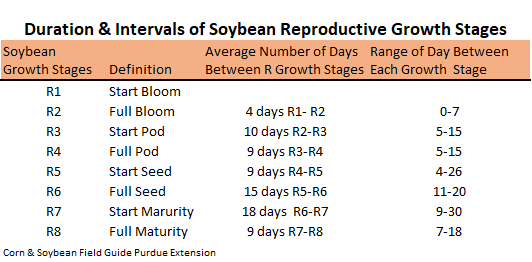
R3 – R4 is pod development: During this growth stage the blooms have already pollinated, and the pod will start to elongate out of the bloom at one of the upper 4 nodes.
- Rapid and steady dry matter accumulation
- Seeds and pods are most vulnerable to abortions
- Seed count is reduced and weight per seed is reduced
- Stress can impact how many blooms successfully produce a pod
- Planting dates can have a significant impact on pods per plant
- Planting dates: May 1st – 37, May 30th – 32, Jun 6th – 25
R5 – R6 is pod fill: During this growth stage the pods are deciding how many total beans per plant
- Rapid remobilization is taking place to supply needs to the pods’ and beans’ development
- Maximum root growth has slowed or stopped (Compaction)
- Nitrogen fixation has capped out (Additional nitrogen??)
- Maximum plant height
- Maximum number of nodes
- Maximum total leaf area
- Maximum pod set
- Maximum total beans per plant are set
- Maximum weight per seed is set
Use the tool below as a score card to determine where yield was established and lost in each field or even on a Max Yield trails (when comparing treatments).
The numbers that are used were from a real observation of a soybean plant that was planted in West Central Illinois on April 25, 2018.
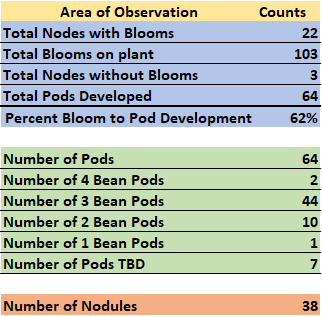 |
Observation from plant evaluation:
Between now and Relative Maturity, it will be important to track how many of these 64 pods produced beans, and at the number it was originally allocated. Stresses such as insect feeding, nutrient availability, disease pressure and reduced sunlight are all factors that can contribute to these top end numbers decreasing and ultimately reduce the established yield.
|

Steinacher is an ISA CCA Soy Envoy alum and currently supports ISA on agronomic content as well as serving as an Illinois CCA board member. He was recently awarded the 2020 IL CCA of the Year & the 2021 International CCA of the Year. He has over 15 years agronomic experience, currently working with AgriGold and GROWMARK previously. Steinacher has an associate degree from Lincoln Land Community College, a B.S. in agronomy and business from Western Illinois University and a master’s degree in crop science from the University of Illinois at Urbana-Champaign.


 and then
FIND US ON