
Over the course of the 2018 growing season, I was challenged to review a few different soybean-scouting apps that are available on both iOS and Android platforms. And, after sampling several options that are currently available, I found some were informative but rather difficult to maneuver, or just too plain clumsy and complicated to make them of use in my opinion.
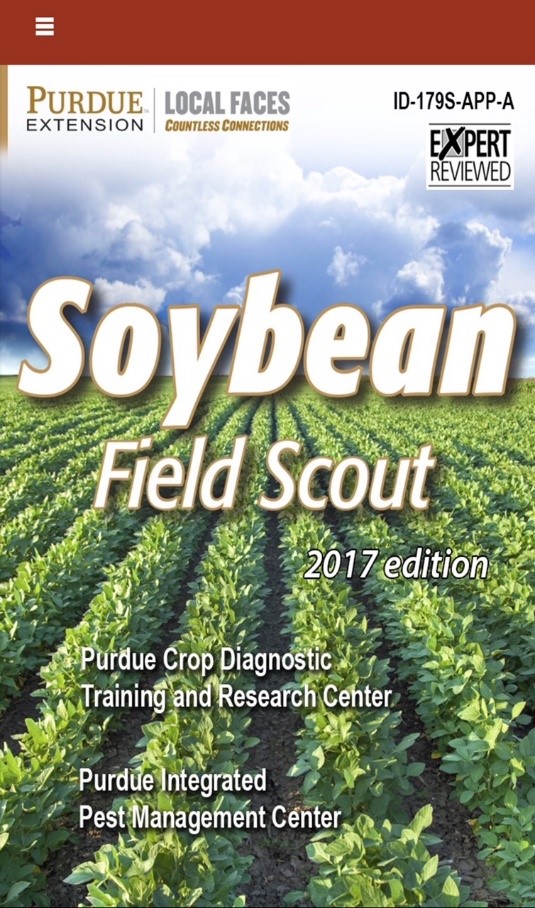
However, I did find one app that suited my taste and impressed me in several respects. The Soybean Field Scout for Android and iOS – 2017 edition, created by the Purdue Crop Diagnostic Training and Research & Purdue Integrated Pest Management Centers. This app was far and away the most intuitive, informative and affordable option I sampled. Honestly, it may be one of the best apps I’ve purchased in recent memory for a measly $5.99 (plus tax).
The incredible amount of diagnostic information available and the ease of using the app to quickly search ¬¬for information is rather impressive. The user simply chooses from the six different categories on the home screen.
Categories include:
- Planting, Growth and Development contains information on seeding rates and provides in-depth detail with vivid photos the user can swipe through for every growth stage in the soybean lifecycle. There are also different calculators that are useful in aiding the user in making replant decisions, calculating population and yield estimates, as well as defoliation loss based on growth stage and percent of leaf loss.
- Soils and Fertility provides basic soil sampling technique, pH basics, limestone types with nice explanations on the reaction process, and calculators to aid in correcting pH in mineral or organic soils. One of the aspects of the app that I found most appealing is the quality photos of diagnostic signs of primary and secondary nutrient deficiencies with explanations provided just by swiping down or tapping in the app to enlarge the provided photo of the nutrient(s) in question.
- Insects and Nematodes section contains sixteen of the most frequent insect pests with the same quality expandable photos. Additionally, detailed descriptive information with typical damage and timing is followed by sampling and threshold information to aid users in determining if treatments may provide a needed ROI. Another of the coolest options is links providing the ability access free downloads of Purdue Field Crops: Soybean Insect Control Recs right at the tip of your finger. Granted, it is a 2015 version, but I do not believe there are many, if any, new insecticidal active ingredients added in the recent past.
- The Diseases section is as visually appealing and informative as the previous sections. It addresses the fifteen most common soybean pathogens. This section had one of the very few speedbumps that I found in the app, the links to Diseases of Soybean: Fungicide Efficacy for Control on Soybean Foliar and Seedling Diseases (BP-161-W and BP-163-W, respectively) did not work. However, when doing a simple search, I was able to access both documents and the bountiful information suggested within the app. No harm, no foul in my opinion.
- I found the fifth and sixth categories, Weeds and Diagnosing Herbicide Injury and Other Stresses & Yield Loss, within the app to be consistently useful and they provided an impressive treasure trove of diagnostic photos and information at my fingertips.
- And last, but certainly not least, the Field Notes section allows you to keep separate field notes and even drop a pin to consistently mark the real time location. A user can also snap photos in real time or select from your library to document a concern or the severity of an issue and/or even add a photo at a later scouting visit make comparative chronological comparisons.
Even with a few hiccups, I feel this app is well worth the money. This app is easy-to-use, informative and a very functional tool that fits in your hand. And, should the folks at Purdue University update the very few dead-links, they would have an unrivaled product for use by Midwestern soybean producers. This agronomist gives it two thumbs up!

Providing agronomic support and education to sales staff across all crops and geographies in the Dairyland Seed® footprint, Moran also has specific duties for managing Dairyland’s soybean portfolio. Joining Dairyland in June of 2004, he served as a district sales manager in Central and Southern Illinois and in 2010, transitioned into his current role as agronomy product specialist. He holds undergraduate degrees in Earth Science and Agronomy, as well as an M.S. in Crop Sciences from the University of Illinois at Urbana-Champaign.

 and then
FIND US ON