
Do you know how many different modes of action are in your spray tank this fall? How about next spring’s burndown application, or the postemergence pass you’ll need to tackle your summer annual weeds?
If you answered no, you need the 2026 Take Action Herbicide Classification chart. If you answered yes, you still need it – to check your math!
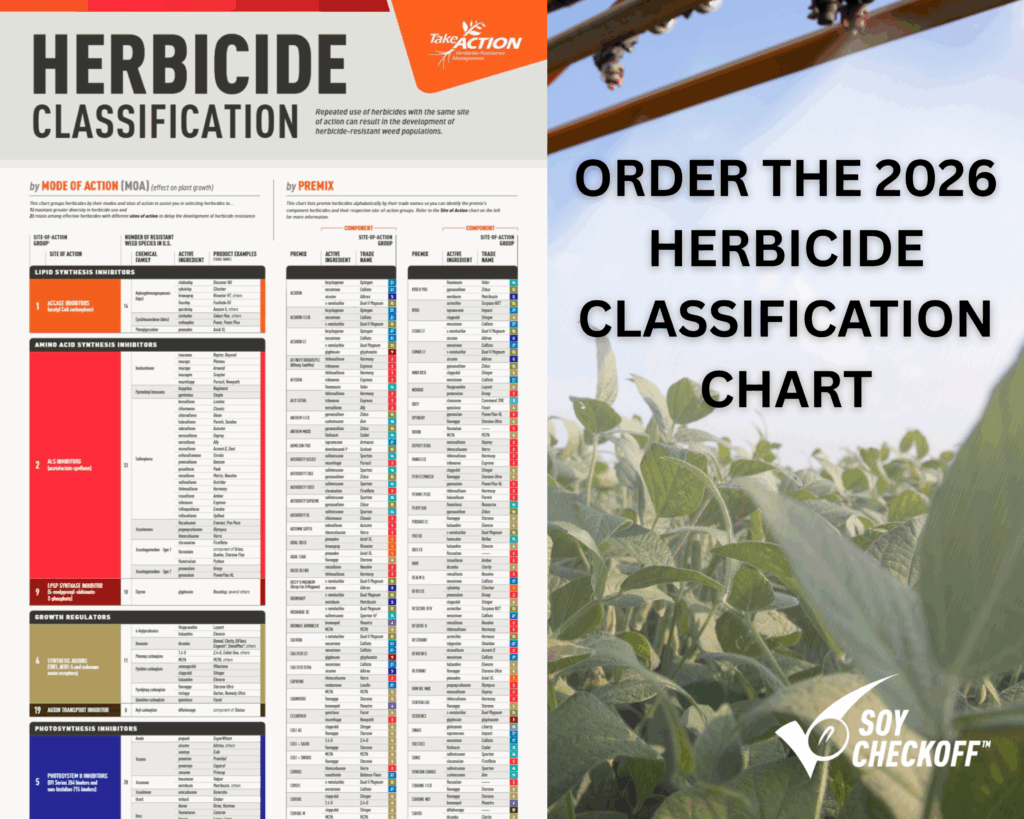
Thanks to the soy checkoff’s sponsorship of Take Action, the Herbicide Classification chart is available for free print orders online. (Photo graphic credit: Emily Unglesbee, GROW)
That’s because simply rotating herbicide products or tank mixing multiple products doesn’t mean you are automatically using multiple modes of action. Commercially branded herbicide premixes may have different names but contain the same active ingredients – and many active ingredients share the same herbicide site of action group. Getting it right matters, because rotating modes of action is a critical component of the fight against rising herbicide resistance.
It’s a complicated landscape for farmers, and products can change every year. That’s why the United Soybean Board sponsors the annually updated Herbicide Classification chart, through its farmer-focused Take Action Herbicide-Resistance Management program. Created and updated by Michigan State University weed scientist Dr. Christy Sprague, the chart helps farmers sort through all commercially available herbicides in the major row crops to learn exactly what active ingredients they contain – and what modes of action each one represents.
The chart is broken down into two reader-friendly sections:
- A color-coded Mode of Action chart, listing every herbicide site of action group and:
- The number of resistant weed species to that site of action in the U.S.
- Active ingredients within that site of action
- Examples of branded commercial products containing each active ingredient
- APremix Herbicide Product chart, which lists commercially available premix products and:
- The active ingredients in each premix
- The trade name of each active ingredient
- The site-of-action groups for each premix
The chart is a powerful tool for an industry facing a growing epidemic of weeds with resistance to one or more herbicide sites of action. Use it every year to help craft a herbicide program that incorporates multiple herbicide modes of action within tank mixes and across seasons.
Thanks to the soy checkoff’s sponsorship of Take Action, the Herbicide Classification chart is available for free print orders, up to a certain amount.
You can place your order here. Looking to stock up for the rapidly approaching winter meeting season? Order soon, to give plenty of time for your charts to arrive!
This post was re-printed with the permission of GROW.
About the Author: Emily Unglesbee



 and then