
Soybeans are emerging across Illinois, with planting progress considerably ahead of the five-year average (20% of Illinois soybean acres planted by April 19 in 2026 versus 7% from 2021 to 2025 per USDA NASS). We even have relay-cropped soybeans (planted March 26) at the V1 growth stage in Belleville, IL!
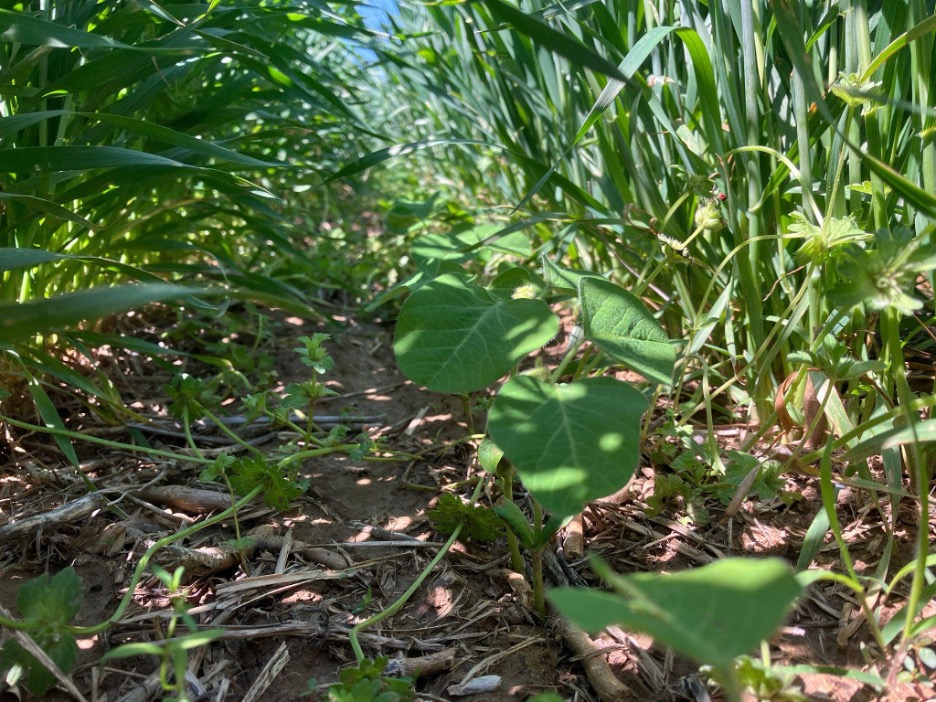
Photo: Soybeans at the V1 growth stage that were relay-planted into wheat on March 26, 2026 at the Southern Illinois Research Center in Belleville, IL. Photo Credit: Nathan Johanning
So, let’s talk about three common misconceptions during early soybean development based on collaborative outreach by our national Science for Success team. Science for Success is a group of Extension Specialists and faculty with soybean responsibilities at land-grant institutions across the nation who collaboratively deliver best management practices to U.S. soybean farmers through coordinated research and outreach.
Misconception: Suboptimal stands (<80,000 plants/A) call for an automatic replant
Research-based Reality: Early season challenges, such as frost, hail, slugs or deer pressure, can lead to questions about soybean replanting. Research across the Midwest shows that soybeans can be close to their maximum yield potential with stands as low as 50,000 plants/A. It is encouraged to wait until the VC (vegetative cotyledon) growth stage to assess final stands and determine if replanting or repair-planting (planting only parts of the field) is necessary. Both planting date penalties and cost of replanting should be considered in decision-making on replanting.
Misconception: Soybean plants need to have uniform emergence to maximize yield
Research-based Reality: Emergence uniformity is generally not critical in soybeans. Previous research has shown that soybeans can emerge over three to four days, but uniformity of emergence generally does not impact final yield at agronomically normal plant populations. Soybeans have an amazing ability to compensate for open space by developing branches.
Misconception: Supplemental nitrogen applied at planting is essential for maximizing soybean yield in high-yield environments
Research-Based Reality: Despite a large nitrogen demand for high-yield soybeans, research across the Midwest has shown that applying nitrogen at planting is rarely economical. This is supported by recent research specifically from Illinois, conducted by Drs. Giovani Preza Fontes and Emerson Nafziger. Typically, nitrogen supply from biological N-fixation and soil N mineralization are adequate for soybean demand even in high-yield environments.
To find more misconceptions across soybean growth stages and research-based realities, our Science for Success team has developed a comprehensive resource that can be found here.

Rachel Vann is a Cropping Systems Agronomist and Extension Specialist in the Crop Sciences Department at the University of Illinois Urbana-Champaign. She is dedicated to advancing effective cropping systems through innovative research, interdisciplinary collaboration, and impactful outreach. Her work focuses on improving row crop management and integrating specialty grain crops into diverse rotations to enhance agricultural resilience and productivity. Rachel serves as the Principle Investigator of the Science for Success initiative which brings together more than 25 soybean Extension experts from across the United States to collaboratively deliver soybean best management practices. Prior to working at UIUC, Rachel was an Associate Professor and Soybean Extension Specialist at NC State University.


 and then
FIND US ON