
We all know there are many factors that affect soybean yield throughout the growing season. Given that many cannot be controlled, greater emphasis must be placed on the areas we can influence. Four key factors to keep in mind are stand density, planting date, maturity group and genetic yield potential. What makes these decisions so powerful is that the payoff comes from planning, not spending.
Before the planter ever reaches the field, management decisions already account for roughly 15% of soybean yield. While that may seem like a small portion, data from thousands of GDM Multi‑Environment Trials across the U.S. show that an incorrect variety and planting date combination can reduce yield by 10 to 12 bushels per acre.
As a grower, it is easy to get a narrow focus on seeding rate and stand count. While they are critical, there is rarely any significant yield loss when planted at the recommended stand density. We, as GDM agronomists, have shown this in our multi-year population study with stands as low as 50,000 plants/A. Anything below that rate for a final stand should be replanted. Historical weed pressure and herbicides used should be taken into consideration.
Unlike many crops, soybeans respond to open space by adjusting their growth habits rather than losing yield. Prioritize planting date and genetic selection, not stand counts alone. Figure 1 shows that, when compared with genotype and planting date, not a single region falls below the penalty threshold into the area of loss from stand density (Chart B & C).
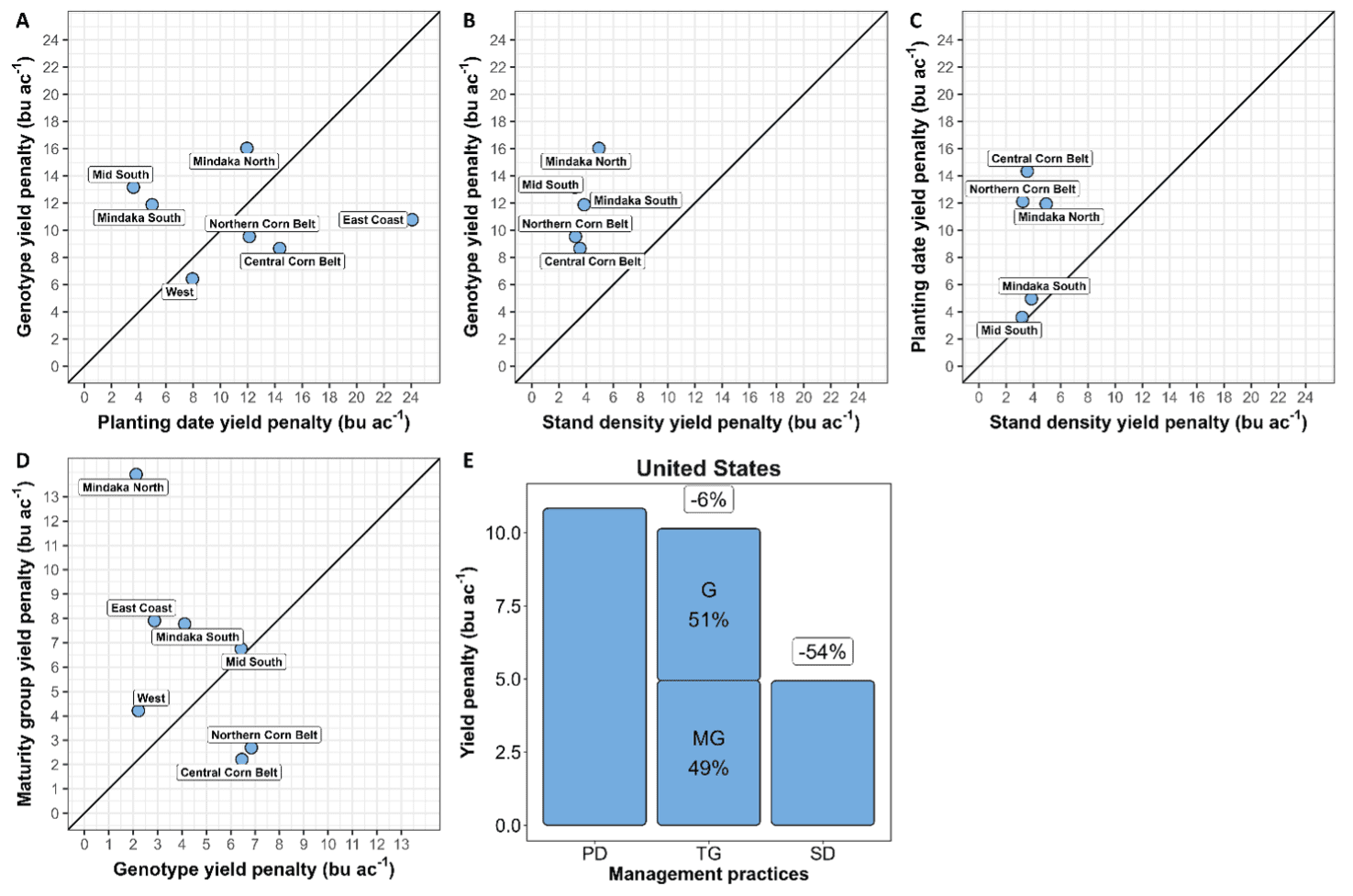
Figure 1 – Scott Krone, GDM Seeds
Farmers know that planting too late is when the greatest yield loss will be seen, but knowing when that time frame occurs is important. According to GDM’s extensive trial network that started in 2019, we have found that there is a critical planting date. Anything planted after that critical date will suffer yield loss.
In Illinois, every day you plant after May 24 in low-yielding environments, a grower can expect to lose 0.75 bu/A per day. In high-yielding environments, that number is 0.5 bu/A per day loss for soybeans planted after May 18. At a national level across all states and yield environments, the critical planting date is May 10, and for each day after that critical date, yield drops 0.4 bu/A per day. This can be observed in Figure 2 in the Corn Belt chart. In the Corn Belt, a wrong planting date could drop yield 12 to 15 bu/A (Figure 1, Chart A).
Continuing onto the significance of maturity group and genotype, it comes down to region. In the Northern and Central Corn Belt and the Mid‑South, top‑end yield is driven primarily by genotype selection. In contrast, regions such as the Dakotas and the East Coast place greater importance on selecting the appropriate maturity group. The penalty for picking the wrong genotype in the Corn Belt could be high as 6 to 7 bu/A (Figure 1, Chart D). In Illinois, it is important to work closely with your local agronomist to get the best data for variety selections.
Capturing every bushel and protecting profitability starts by knowing which lever to pull hardest on in your region. In the Corn Belt, pre‑planting decisions increase in importance from stand density to maturity group to genotype, with planting date having the greatest impact. I encourage you to set aside a few acres to test these simple trials on your farm. Only then will you know exactly what works in your area, optimizing yield and protecting your bottom line for years to come.
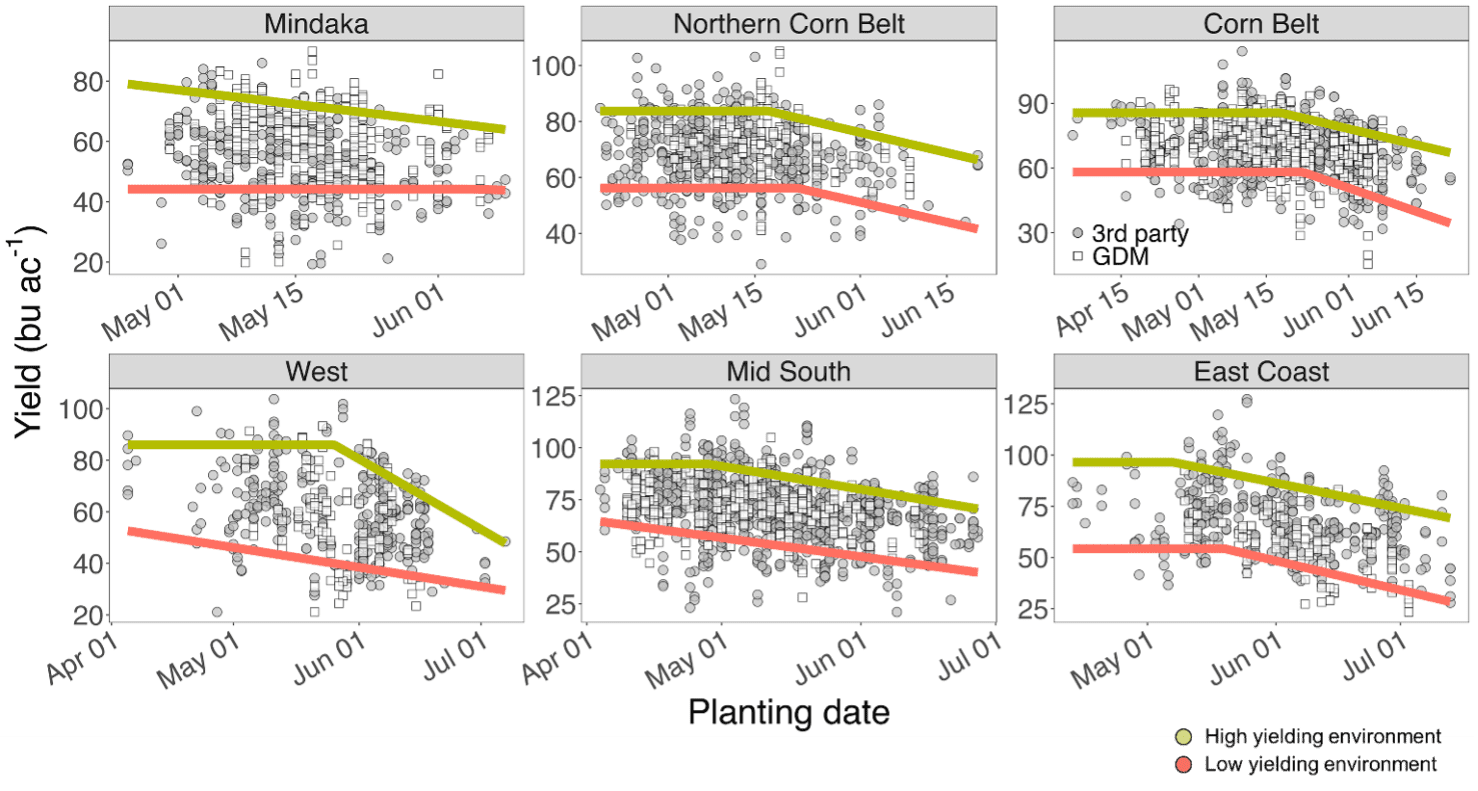
Figure 2 – Scott Krone, GDM Seeds
Key points:
Know your key maturity group and the tolerable range
Know the critical yield loss day for your area
Know your optimal stand density and limits for your region
Work closely with your local agronomist in choosing the best practices
To find more management practices that suit the Illinois growing environment click here.
Reference:
“Management Decisions That Drive Soybean Yield.” DONMARIO Seeds. January 2026.

Scott Krone is a Product Development Agronomist for GDM Seeds. In his role, he advances products out of the experimental stage and into the commercial pipeline. He serves as a point person, reviewing product lifecycles and technical support to branded and distribution channels. After growing up in Edwardsville, IL, Scott earned a bachelor’s degree in Crop Science from the University of Illinois Urbana-Champaign in 2019. Recently, Scott met all the requirements to become a CCA and has been approved by the board. Scott is an Illinois Soy Envoy for the 2026 growing season.


 and then
FIND US ON