
The crops grown in production agriculture have a very high value and achieve optimum yield when they have little competition for resources. Therefore, in most soybean fields we tend not to find much diversity in the vegetation. All of the plants in an 80-acre field can be genetically identical and will taste the same to a hungry pest. All of the soybean plants will also have the same genetic flaws and weaknesses, which opportunistic pests will take advantage of.
Many genetic lines for both soybeans and corn have been bred to tolerate certain levels of pressure before presenting damage that could cause substantial economic losses. Crop fields tend to create large areas of monoculture environments for many pests to thrive. However, breeding has not made plants 100% safe from insects and disease.
When a pest outbreak occurs, farmers may ask when it occurred and they may wonder if another pest is on the way. It’s important to know that an infestation doesn’t just appear within a few weeks. Many times, pest invasions build over the course of several weeks or months. It’s important to not only know the weakness in the genetic lines, but also the seasonal pests that should be scouted. Below are some tips for setting up a good scouting program on your farm.
Develop a scouting program:
a. When will each field be scouted?
- We will scout each field on Monday morning
- We will scout each field every so many GDU accumulation
b. Who will be scouting the fields?
- Scouting will be done by a hired scout
- Scouting will be done by a local intern
- Scouting will be done by ___
c. How will the scouting reports be generated?
- All information will be recorded on a paper form
- All information will be recorded on an app
- All information will be recorded on a spread sheet on an iPad
d. How will the scouting reports be communicated to key partners?
- All documents will be emailed to ___
- Items of high or medium priority will be texted to ___
e. What are the scouts specifically looking for during specific times?
- Early Season Scouting:
- Emergence issues: disease, insect feeding, crusting, etc.
- Quality of the stand: stand counts/replant concerns
- BLB feeding: amount of feeding
- Weed pressure: what are they and how big
- Mid-Season Scouting:
- Insect pressure
- Root development: compaction issues
- Nodulation: take counts
- Tracking growth stages: what vegetative or reproductive stage
- Disease: what’s the potential threat of SDS, frogeye
- Nutrient deficiency
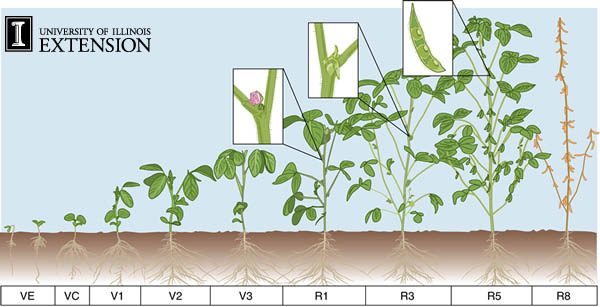 The chart to the right, gives a great visual of the growth timeline of a soybean plant. Understanding this chart and when soybean plants are most vulnerable is key to knowing when and what pests to look for that will impact yield. It’s important to network with regional and university agronomists to anticipate which pests you should be scouting. With modern technologies, it’s very easy to hear from these individuals (social media, university newsletters).

Steinacher is an ISA CCA Soy Envoy alum and currently supports ISA on agronomic content as well as serving as an Illinois CCA board member. He was recently awarded the 2020 IL CCA of the Year & the 2021 International CCA of the Year. He has over 15 years agronomic experience, currently working with AgriGold and GROWMARK previously. Steinacher has an associate degree from Lincoln Land Community College, a B.S. in agronomy and business from Western Illinois University and a master’s degree in crop science from the University of Illinois at Urbana-Champaign.


 and then
FIND US ON