If you have lived for very long in an area where soybeans are grown, you’ve likely passed more soybean plots than you care to count. Most people drive by them without a second thought. Most farmers even drive by them without giving them much thought, other than they’re a pretty product showcase for a seed company. They’re so common we take for granted what there is to learn from them. They take a fair amount of time for farmers, seed dealers and agronomists during very busy seasons to put in and take out. So, what is there to learn from plots anyway?
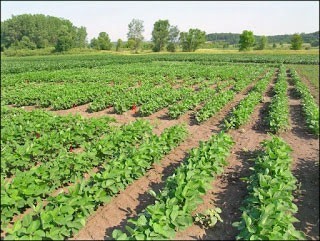
At their core, plots are small scale field-level research sites where differences between varieties, practices or treatments can be seen and evaluated. These trials can be independently or commercially organized and run by individual farmers, groups of farmers, universities, seed companies or agronomists.
Plots are the basis for the yield data that buzzes around the industry. Billions of dollars’ worth of decisions are made off plot data with yield being one of the most talked about outcomes of trial data. It’s very important when evaluating plot data to look at the region, soil type, growing conditions, replications and variance in repeating checks to determine confidence in a single plot or set of plots. The more data points, the more confidence there is in a yield advantage.
To determine yield advantage in an area or specific area, several plots showing the same yield advantage need to be seen. Even then, that only proves an advantage for that growing season in the set of conditions experienced in that area. That’s where the usefulness of plot data from sites far away from your location can also be useful. These results provide a snapshot of performance on a different set of conditions than you experience locally.
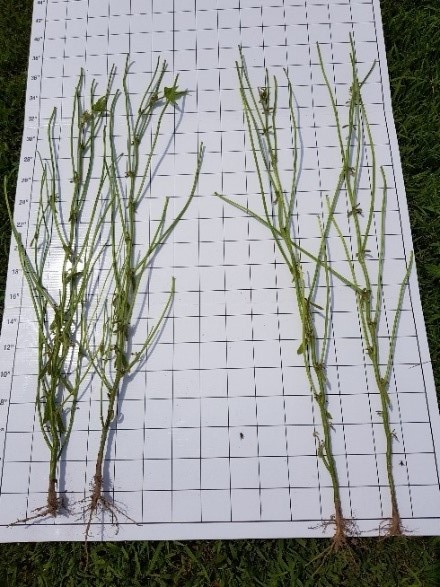 On a practical level, what does all of this mean for someone who isn’t a professional researcher in agriculture and who doesn’t have time to look through dozens of plots across wide geographies? My advice to anyone interested in a new practice, variety or treatment is to find a plot close to where you live and go look at it at least three times in a growing season. There is so much that can be learned by visually inspecting plots during the growing season that will be missed if nothing but yield results are considered at the end of season. Here is a prime example. In 2018 I had a grower who was interested in an application of a plant growth regulator applied on soybeans. I had a small quantity of demo product and put in a small plot with a hand boom sprayer. It was too small to get valid yield results, but in the picture to the right is just one of many eye-opening observations we made that year. We saw substantially more branching, nodes and more advanced pod set. There was enough visual response that despite a lack of yield data, the producer decided it was an application he wanted to continue experimenting with.
So as we look toward the 2021 growing season, there are a few key takeaways I’d recommend for any producer. There have been a couple of new trait platforms that came on the market in 2020 with dozens of new varieties and another which should be released for 2021 bringing dozens more. Don’t go into seed purchasing season blind. If there are trait platforms or varieties you are interested in, challenge your local seed dealers and agronomists to take you to plots where you can evaluate these products.
This time of year, there are several things you can learn about potential varieties for your farm. I would recommend looking at plant structure for adaptation to your row width, plant height, number of nodes, pods per node and any disease issues rearing their heads. One of my favorite things to evaluate preharvest is seed size. I’ve been in the business long enough to think of more than a handful of varieties that will produce a similar number of pods and seeds per pod as the varieties they’re next to, but consistently produces larger seeds and more bushels per acre as a result. Seed size will change somewhat year to year and field to field, but there have been those lines in the past that would on average pay you back good dividends for any inconvenience of slightly larger seed sizes.
It’s never too late to become a student of your crop. A curious mind, small experiments and careful observations can lead you on the search to uncover hidden yield potential you possibly didn’t know existed. Surround yourself with information and advisors who you challenge and who will challenge you back. Watching, studying, looking and learning can pay you big dividends in 2021 and for the rest of your career.

Jason Boehler is a Certified Crop Advisor and Certified Crop Specialist as well as a seed specialist at M&M Service Company. He specializes in advising growers in agronomic practices, fertility, chemical and seed genetics to maximize yield potential and economic return on investment for each farmers’ environment. Boehler holds a bachelor’s degree in agriculture science with an emphasis in agronomy from Western Illinois University. His wife Kayli and he are raising two daughters near Litchfield, Illinois, where he farms corn, soybeans and forages with his father.

 and then
FIND US ON