
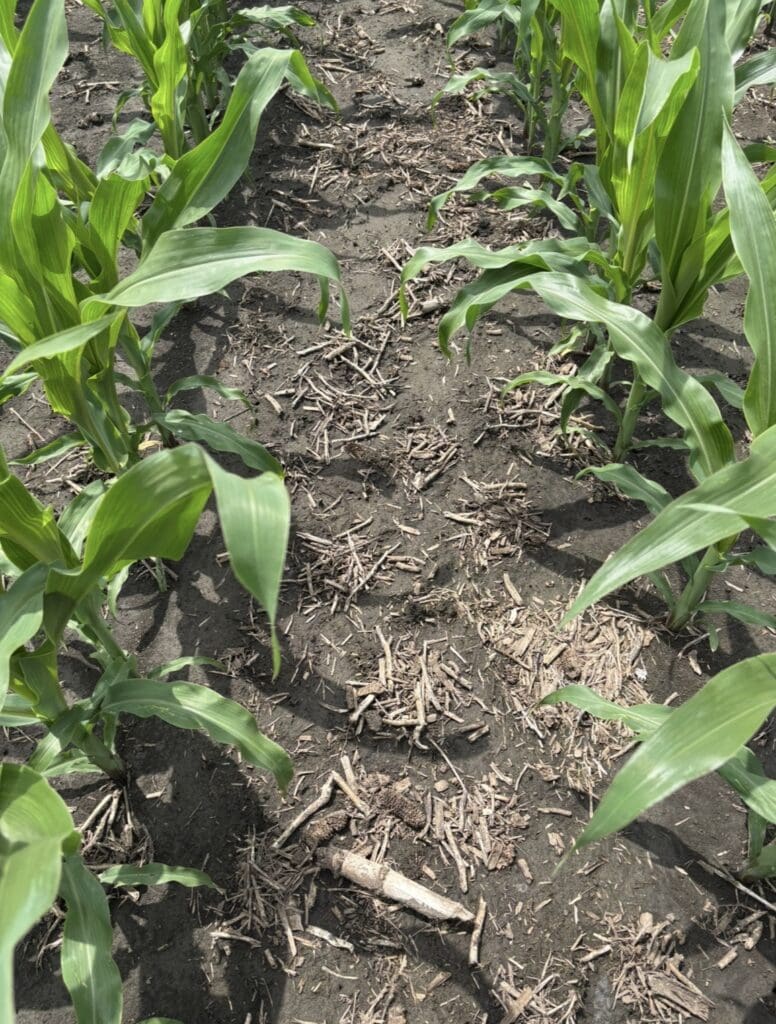

The most significant issue, encountered over the past two weeks, has been PPO herbicide injury to seedling soybeans. The most disturbing aspect of that injury has been how easily it can be missed.
In multiple cases, green plants have been present, and stand has seemingly looked okay. Unfortunately, excavation has shown extensive wounding at the soil line in some cases. In a few cases, this damage (girdling) was significant enough that late-season survival seemed questionable. We should emphasize that this has been the most significant field call issue to date, but issues of PPO injury are not present at epidemic levels.
Where the issue has been significant, growers have typically overseeded to get stands near a final 100,000 plants per acre.
Our cold spell also allowed Group 15 veinal strapping to appear in soybeans, resulting in heart-shaped leaves. Some leaf tissue eventually developed a tattered appearance as developing leaf tissue surpassed stunted veins. While an interesting observation, those issues do not seem to represent anything of economic significance.
While the above represents a small degree of issues in the field, the overall appearance of the crop has been very positive. The color change for both corn and beans is coming on in earnest. Both groups are finally getting that dark green color that makes the countryside seem just a little brighter.
The corn crop is closing rows in the earliest planted of fields, with those fields now hitting the several leaf stage. The advancement of that crop has created typically seasonal pressure to get spraying done within label restrictions. Corn roots are nearing the mid row in those earliest fields as well.
The wheat crop continues to appear extraordinarily early.
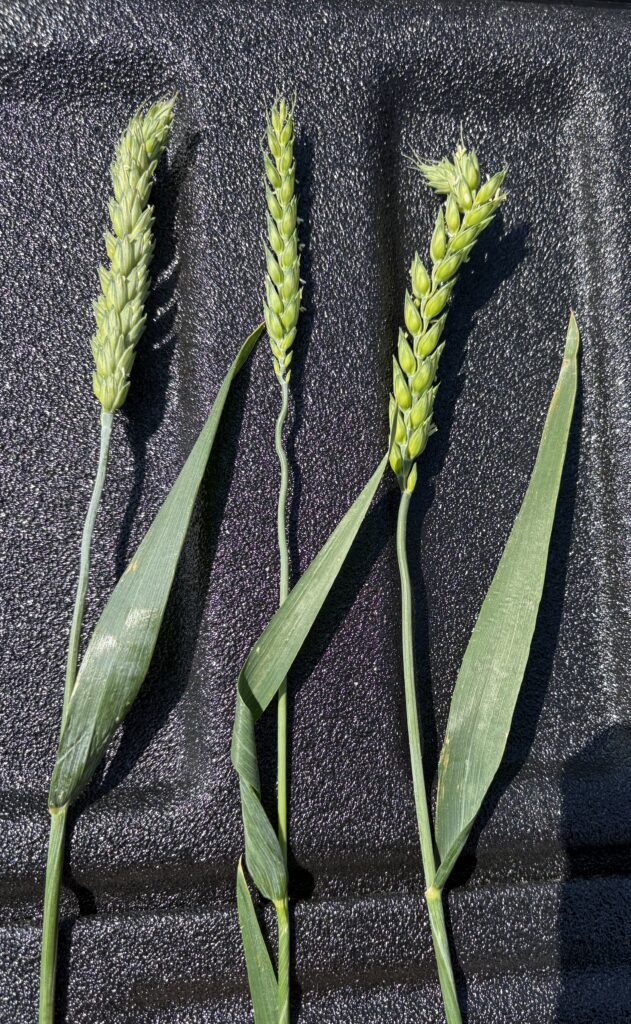
Green has begun to fade from the wheat crop, and one gets the sense that crop growth and development has been a little lopsided this year. One occasionally notes crimped wheat heads that are not caused by any type of herbicide application. Our best assessment? The sudden move from very warm conditions to last month’s very cold conditions – resulted in something akin to rapid growth syndrome. The leaves of the boot stage could not get out of the way (fast enough) for the emerging head. This caused the stem below the head to zig zag and bent the head upon emergence.
Head scab is evident if you look close enough, and one suspects that growers will be thankful they used fungicide this year.
Hold on tight, because crop canopy will shoot up dramatically over the course of the next week.
EMAIL SIGN UP
Sign up to receive our newsletter for up-to-date news and offers directly in your inbox:
LINKS
FOLLOW FIELD ADVISOR

The Illinois Soybean Association (ISA) checkoff and membership programs represent more than 43,000 soybean farmers in Illinois. The checkoff funds market development, soybean production and government relations efforts, while the membership program, Illinois Soybean Growers (ISG) and the Illinois Soybean Growers PAC actively advocates for positive and impactful legislation for farmers at local, state and national levels. ISA upholds the interests of Illinois soybean farmers through promotion, advocacy, research and education with the vision of becoming a trusted partner of Illinois soybean farmers to ensure their profitability now and for future generations.
© 2026 Illinois Soybean Association

 and then