
Bean Leaf Beetles … Wait, didn’t we already battle them during the spring? Yes, but this insect will have two adult generations in a single growing season. After overwintering, the BLB emerged and fed on soybean cotyledons this spring. The adult insect then laid eggs for the second generation that will feed on the 2020 pods. Soybean fields planted with an insecticide seed treatment would have had a degree of protection against spring feeding (depending on when the beetle attacked the seedling).
The spring BLB—or the first generation—will typically attack an early planted field or the first field that emerges in each area. Soybeans can withstand more occasional stresses than corn; however, once a soybean plant starts to enter R4.5 it’s especially important to protect leaves, blooms and pods from stress like BLB.
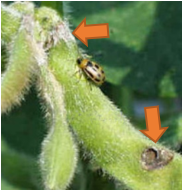
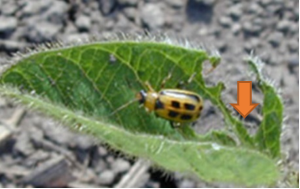 Type of damage:
- Leaf feeding: reduced leaf area for photosynthesis
- Pod feeding: if feeding near the base, “pod clipping” could occur and the full pod is lost
- Transmission of bean pod mottle virus
- Reduced yield and reduced grain quality
Proper Identification:
As with any other pest, it is important to properly identify the BLB. The BLB can show up in soybean fields in several different types of colors such as red, yellow, brownish, etc. In many situations, they can be mistaken for corn rootworm adult beetles. The best way to tell them apart is to look for the black triangle behind the neck found on the bean leaf beetle.
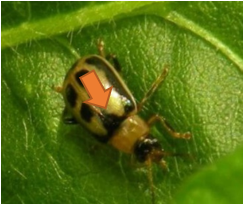
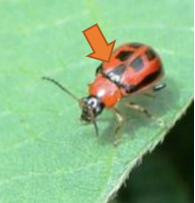
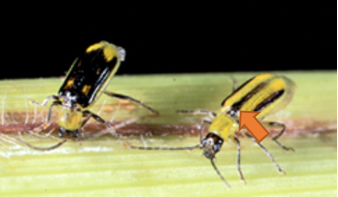
The left two images are of adult Bean Leaf Beetles. Note the black triangle behind the neck. On the right is an adult Corn Rootworm Beetle.
Management:
It seems like in modern soybean production everyone has a different threshold for when to treat.
- Conduct several field sweeps and determine BLB counts. Evaluate the growth stage of the soybeans and potential risk. Follow link below for instruction on sampling and thresholds
- Proactively treat with an insecticide application when applying fungicides during R3-R4. This approach tends to find a strong ROI. However, remember that every time an insecticide is applied to a field, beneficial insects are also being terminated. Evaluate your short- and long-term options.
- Insecticide seed treatments can provide a level of protection against the spring adult, but there is no guarantee this treatment will reduce the likelihood of the second generation feeding during pod fill.
- Its important to seek advice from an Illinois CCA who can help provide pros and cons for management practices.
Follow this link for more details on BLB (Life Cycle and Thresholds)
Bean Pod Mottle Virus link:

Steinacher is an ISA CCA Soy Envoy alum and currently supports ISA on agronomic content as well as serving as an Illinois CCA board member. He was recently awarded the 2020 IL CCA of the Year & the 2021 International CCA of the Year. He has over 15 years agronomic experience, currently working with AgriGold and GROWMARK previously. Steinacher has an associate degree from Lincoln Land Community College, a B.S. in agronomy and business from Western Illinois University and a master’s degree in crop science from the University of Illinois at Urbana-Champaign.


 and then
FIND US ON