
Are your soybean plants nodulating and fixing nitrogen or do you just assume they are?
Nitrogen is 1 of 17 essential elements that all plants need to grow and reproduce, however, soybeans and other legume crops can produce a large percentage of their total requirements. Most producers invest a substantial amount of time planning, calculating needs and applying nitrogen for a corn crop, which needs about 1.1-1.2 units of nitrogen for each bushel produced. It’s equally important to spend a similar amount of time reviewing the nitrogen supply/demand variables for soybeans, which require nearly 4 to 5 lbs. of nitrogen for each bushel produced. Even though soybeans can convert and fix their own nitrogen, is this still enough to keep up with high-yielding demands, especially when we are pushing 80, 90 or even 100 bushels?
Nitrogen Fixation: This is a symbiotic relationship between the soybean roots and the soil bacteria population. The roots provide the bacteria with a food source (energy) and in return the bacteria provide the soybean with nitrogen factories located on the roots (nodules). Once the bacteria have colonized on the roots, they create nodules which convert atmospheric nitrogen (non-plant available) into ammonium nitrogen (plant-available).
The success of the nodules depends on the quality and quantity of the bacteria population. In recent years, soybean producers have been exploring inoculating soybean seeds to help spark this process. This treatment puts a physical bacteria population on the seed to help increase the opportunity for maximum nodulation and nitrogen fixation. This process will typical start during V2-V3 and the nodule development and nitrogen fixation will peak around the R5 growth stage. There is a lot of current research evaluating the value of applying nitrogen to soybeans during the time when nodule fixation is reducing and rapid demand for nitrogen increasing going into pod-fill growth stages.
Evaluating the Roots: Your first step is to evaluate how well your soybean crop is nodulated.
- Dig up 10 – 15 plants in each area (good areas and bad areas)
- How many nodules are produced?
- Early in the season 5 – 8
- Later in season should find 8 – 20
- Where are the nodules located on the root system?
- If they are located near the tap root, they are from recent inoculation.
- If they are located on the lateral roots, they are from natural field population.
- How many nodules are actively working/fixing nitrogen?
- If the inside color is white it’s not actively working yet.
- If they inside color is pink its actively working to fix nitrogen.
- If the inside color is brown it’s no longer working to fix nitrogen.
There are several field conditions that can decrease the bacteria population, which will reduce the nodulation and total nitrogen production. Roughly 50% of the total nitrogen supply is coming from the bacteria relationship and fixing atmospheric nitrogen. If field conditions are not ideal for colonies to thrive and partner with soybean roots, then it’s fully up to the soil to supply all the nitrogen needs.
Poor Nodulation Field Conditions: If nodulation is poor, there are several possible causes.
- If the field has been out of soybeans for several years, the natural population could be reduced.
- If fields currently have high levels of nitrogen (manure, other legumes, nitrate-nitrogen).
- If fields have been flooded or areas typically lay wet, based off soil type or topography, this can create oxygen-deprived environments which aren’t ideal for bacteria to survive.
- A balanced pH isn’t just good for basic soil fertility, it can also influence the population and longevity of the bacteria. If a soil pH gets outside of 5.6 – 7.3 issues can become noticeable.
- Lower organic soils and coarse soils (sandy) do not provide bacteria the environment in which to thrive and survive, so these fields may have low amounts of nodulation.
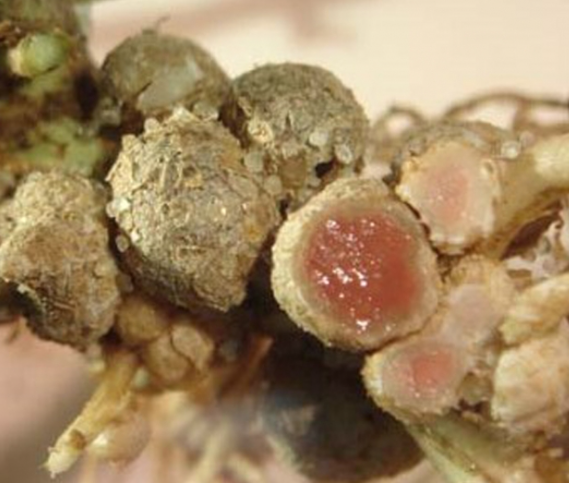
Pink is Good
 |
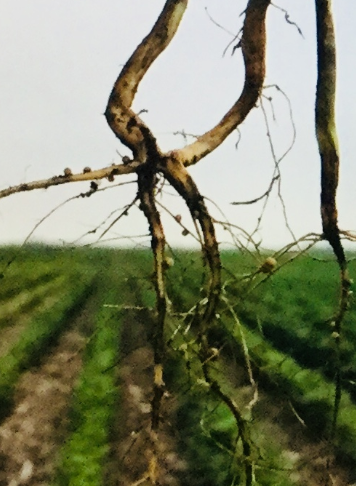 |
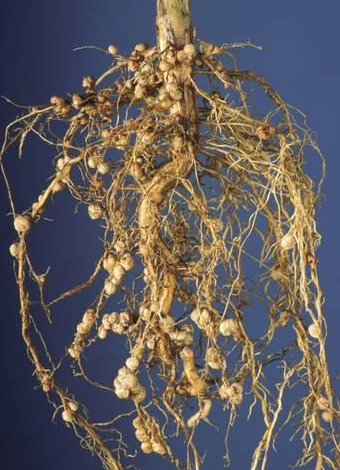
| Good Nodulation | Weak Nodulation |
 |
|
|
No Seed Treatment Inoculant |
Seed Treatment
Inoculant |
Applying Nitrogen to Soybeans: In 2017 a research paper published at the University of Illinois titled “The Use of Fertilizer Nitrogen Application to Increase Productivity of Soybeans” explored how applied nitrogen impacted soybean production. The paper evaluated different forms of nitrogen, different timing of application, different soil types, different weather patterns and different growing seasons. Below are some quick takeaways.
- Nitrogen application can impact root nodulation.
- Total counts
- % of nodules that are pink through reproductive stages
- The type of nitrogen sources can influence yield response
- Pre-plant, V3 & R3 seemed to show the most consistent yield response
- Postponing nitrogen remobilization to seed fill stages (late R4 and R5) will help to improve yield
- Upwards of 50% of the required nitrogen can be produced by root nodules
- This relationship is very important (need to work hard to maintain healthy rhizobia population)
- Soil mineralization can’t consistently supply the other 50% of needs when yields exceed 70 or 80 bushels, soils are low in organic matter or soils are not biologically active.

Steinacher is an ISA CCA Soy Envoy alum and currently supports ISA on agronomic content as well as serving as an Illinois CCA board member. He was recently awarded the 2020 IL CCA of the Year & the 2021 International CCA of the Year. He has over 15 years agronomic experience, currently working with AgriGold and GROWMARK previously. Steinacher has an associate degree from Lincoln Land Community College, a B.S. in agronomy and business from Western Illinois University and a master’s degree in crop science from the University of Illinois at Urbana-Champaign.


 and then
FIND US ON