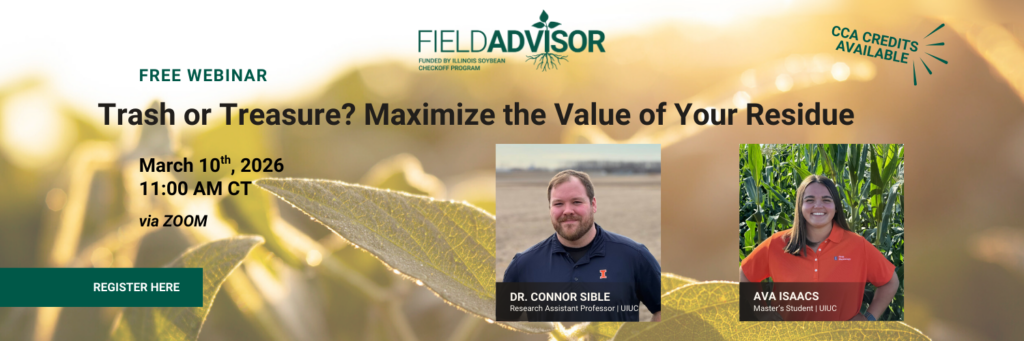
Whether you no-till, cover crop, double crop, or simply have higher yields today than a decade ago, you've got residue in your field. Sometimes we call that residue "trash" because it can create challenges coming planting time. However, we cannot discredit the nutritional value that residue contains to help feed next year's crop and sustain a healthy soil, and suddenly is that "trash" actually "treasure?" The hard part about treasure is that it usually is tough to get to, as can be residue management of our cropping systems. In this webinar, Dr. Connor Sible and Ava Isaacs will review exactly what residue is, how much we're likely to encounter year over year, and summarize recent trial work on residue management conducted by the Crop Physiology Lab at the University of Illinois.
Presenters:
Dr. Connor Sible is a Research Assistant Professor in the Department of Crop Sciences at the University of Illinois, where he also earned his MS and PhD degrees. His research focuses on corn and soybean production systems, with an emphasis on optimizing the interaction between agronomic products and management practices to improve grain yield and nutrient use efficiency. His work includes evaluating biological and biostimulant products, fertilizer strategies, and crop residue management to enhance soil nutrient availability. He regularly presents his research at field days, extension meetings, national trade shows, and international conferences.
Ava Isaacs is a master's student in the Crop Physiology Lab at the University of Illinois. Her research focuses on agricultural biologicals and nutrient use efficiency, with particular emphasis on how biological products vary in efficacy across environments and regions, as well as how their performance changes under different management systems and across hybrid or variety genetics. Her work centers on improving fertilizer use efficiency and evaluating the impacts of biologicals on soil and plant health. The goal of her research is to help farmers better understand this emerging product market as they make input decisions to maximize yield and field productivity.
About the Author: Kelsey Litchfield



 and then