
For years, Red Crown Rot (RCR) in soybeans has plagued Illinois counties like Pike, Madison and Macoupin. Yet, in other parts of the state, some growers have dismissed the disease, questioning whether it’s “real” or “really that bad.”
That skepticism fades quickly when the problem hits home. My family recently discovered RCR on our own farm. I had seen it in my neighbor’s fields before, but for many of us, an issue doesn’t feel urgent until it’s in our own field.
Tracking the Spread of Red Crown Rot Across the U.S.
Once considered primarily an Illinois problem, RCR—caused by the soilborne fungus Calonectria ilicicola—is now appearing across a much wider region. The disease has been confirmed in Kentucky, Missouri, Indiana, Ohio, Wisconsin, Minnesota, Delaware, Virginia and Louisiana, signaling its growing impact on soybean production.
For detailed maps and the latest updates, visit the Crop Protection Network’s Red Crown Rot resources.
From Roots to Leaves: Recognizing Red Crown Rot
One of the biggest hurdles in managing RCR is proper identification. Its foliar symptoms often resemble other soybean diseases, including Sudden Death Syndrome, Brown Stem Rot and Stem Canker.
Early signs appear below ground, with reddish discoloration on roots as early as the V2 growth stage. Foliar symptoms—yellow blotches between leaf veins—typically emerge after R1. Depending on environmental conditions, these may be visible during scouting or from the sprayer cab at R2 but often aren’t noticeable from the road until later.
As the disease progresses, roots rot severely, plants die prematurely, and under humid conditions, the stem base may show reddish-brown spore-producing structures (perithecia) and white fungal growth.
If you suspect red crown rot, send a sample to the University of Illinois Plant Clinic for confirmation.
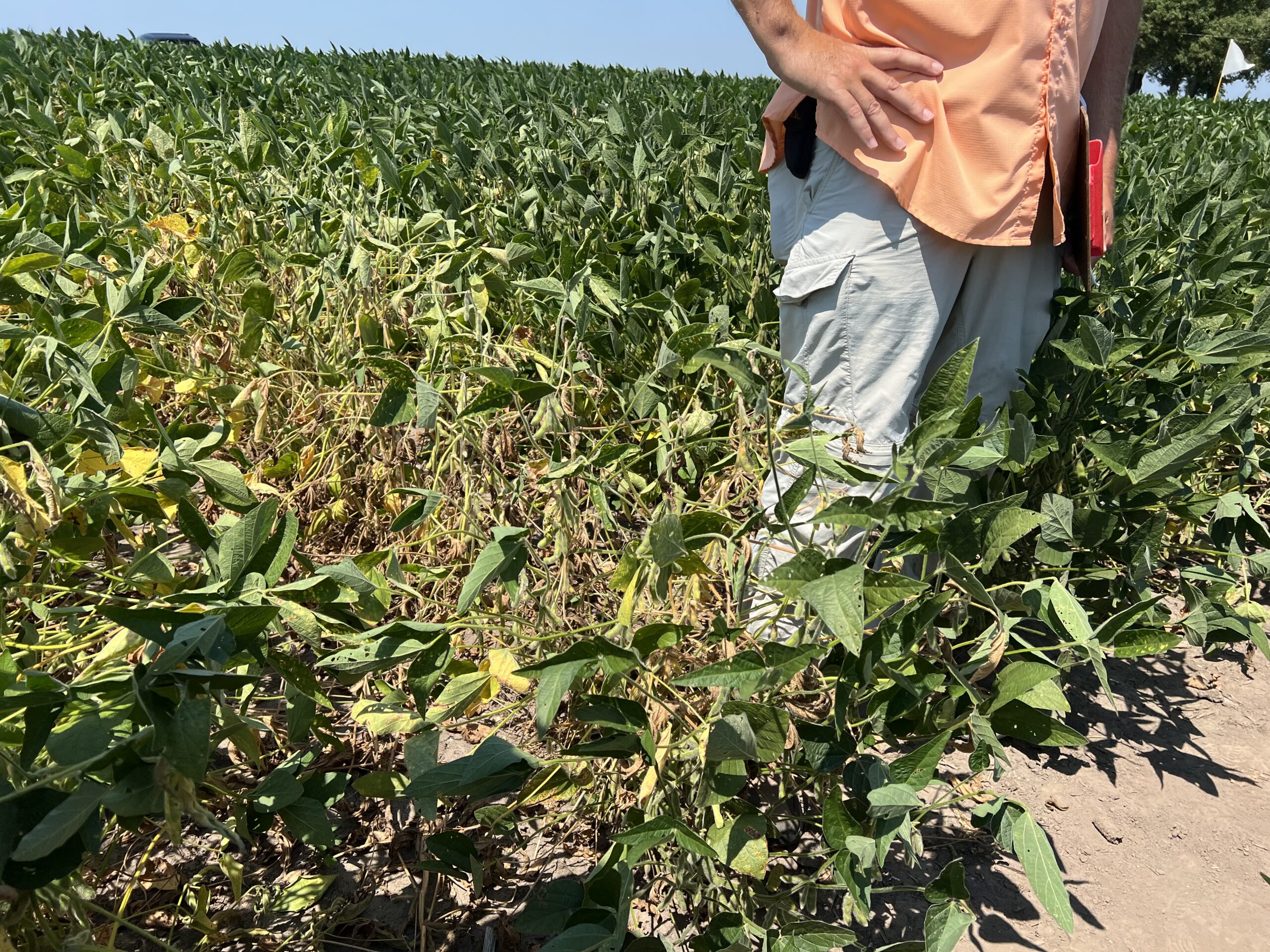
A Beck’s Hybrids soybean trial in Montgomery County, IL during a red crown rot training with Dr. Matt Montgomery. This variety appeared to be more susceptible or affected by red crown rot compared to the other varieties nearby.
Red Crown Rot’s Impact: From Patchy Losses to Major Damage
At first, it seemed that the worst yield losses occurred in fields long infected or with high inoculum levels of RCR, but the impact also depends on multiple factors—the “disease triangle:” soybean variety, environment and timing of infection.
Additional stresses, such as soybean cyst nematode (SCN), soil pH issues, deep planting, compaction or other root diseases, can intensify symptoms. RCR survives on residue and on a broad range of hosts, and researchers suspect there are still unknown hosts.
Early infestations often appear in patches, so yield maps may show yields from 0 to 50 bushels in small areas while overall field averages look good. Over time, however, losses can be severe—40% to 60% in heavily infested fields, and in extreme cases, up to 80% in localized spots under high disease pressure.
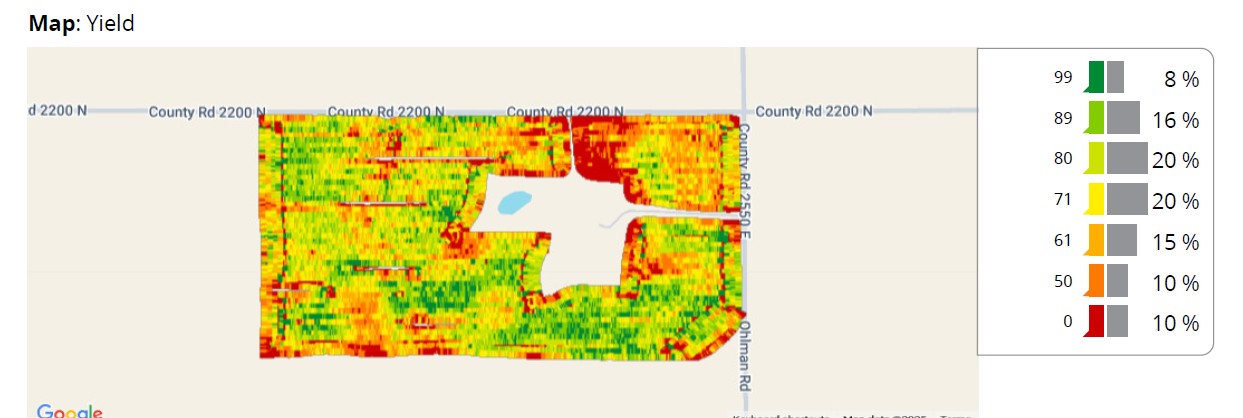
Yield map from a soybean field with red crown rot in Montgomery County, IL
Managing Red Crown Rot: Why an Integrated Approach Matters
RCR is one of the most challenging soybean diseases because there’s no cure once it infects your field. There’s no silver bullet yet, so the best defense is an integrated strategy:
- Improve Field Conditions
- Enhance drainage, reduce compaction and fix low spots to prevent waterlogging—conditions that favor RCR.
- Reduce Plant Stress
- Manage SCN and other root diseases.
- Maintain proper soil pH and fertility to keep plants resilient.
- Choose the Right Soybean Varieties
- Talk to your seed company about variety performance in RCR-prone areas. Pressure them for more insights.
- Consider Seed Treatments
- While seed treatments won’t eliminate the pathogen from soil, they can reduce early infection. Be sure to review and follow all current state-approved product labels before application.
- Victrato® (Syngenta): First federally labeled treatment for RCR
- Saltro® (Syngenta): Approved under FIFRA Section 2(ee) for suppression
- ILeVO® (BASF): Approved under Section 2(ee) for suppression
- Pretium™ SDS (Nufarm): Biological option
- CeraMax® (Ceradis): Biological option
- Research suggests some seed treatments may outperform others, and the good news is that they show promise as tools for managing RCR.
- While seed treatments won’t eliminate the pathogen from soil, they can reduce early infection. Be sure to review and follow all current state-approved product labels before application.
- Rotate Crops
- Plant non-host crops like corn or small grains.
- Avoid legumes such as alfalfa, clover, vetch, and lupine, which can harbor the pathogen.
- Sanitize Equipment
- Clean soil and residue before moving between fields, especially if one is infected—to prevent spreading microsclerotia.
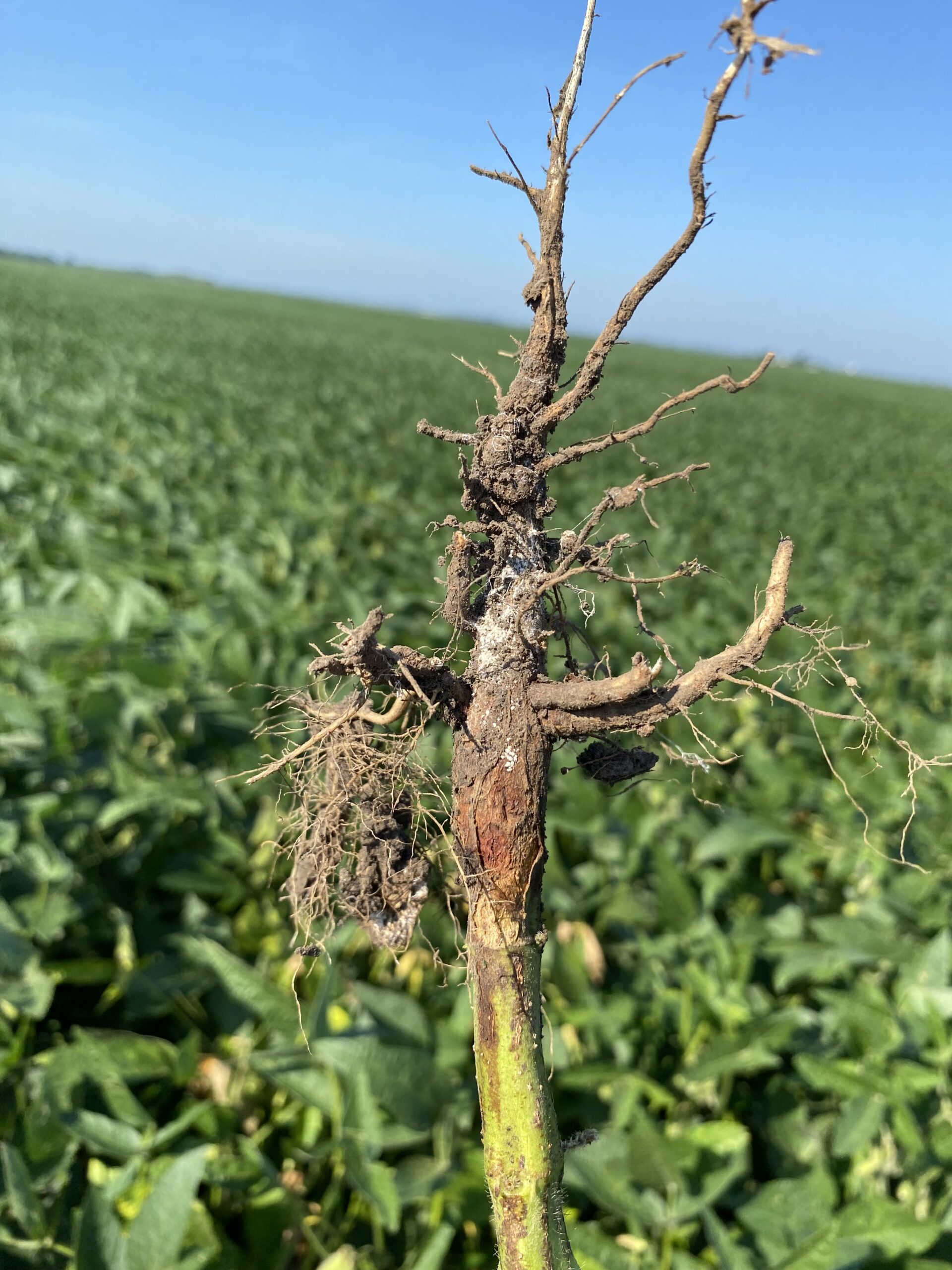
Soybean variety with RCR during the 2025 growing season in Shelby, Co., IL.
Researchers Race to Combat Red Crown Rot in Soybeans
RCR remains one of the most challenging threats to soybean production, and experts say there’s still much to learn about the disease.
USDA researchers in Illinois are working to change that. They’ve developed a streamlined DNA extraction method that delivers results in about 30 minutes and supports PCR and sequencing. In addition, a new high-resolution melting (HRM) analysis system can confirm infections in under two hours—significantly faster than traditional approaches.
Illinois Soybean Association (ISA) is investing checkoff dollars to advance detection and management strategies. Current projects include using satellite imagery to identify RCR hotspots, evaluating commercial products and studying how treatments influence interactions between RCR and SCN.
Collaboration is also ramping up. The United Soybean Board recently hosted a RCR meeting, bringing together plant pathologists from across the Midwest to share research updates, outreach plans, and set priorities for future studies, many of which will require additional funding.
Looking ahead, USDA researchers plan to examine fungicide responses and virulence among roughly 100 sequenced isolates, with the goal of creating molecular markers for fast, field-ready diagnostics. One major hurdle remains: finding infested fields for trials. To help, some growers, including myself, are volunteering fields confirmed with RCR, ensuring research moves forward.
Researchers need your help now. If you have soybean fields showing signs of RCR, volunteering a site for research is critical to developing rapid diagnostics and effective treatments before this disease causes widespread losses. Your participation could make the difference in protecting Midwest soybean production. For more information, contact myself, Stephanie Porter, ISA Outreach Agronomist, at stephanie.porter@ilsoy.org.
About the Author: Stephanie Porter



 and then