
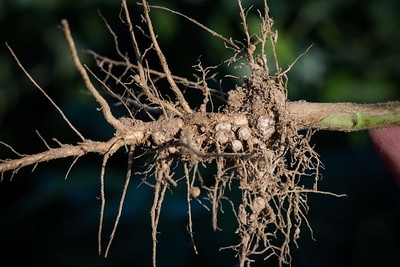
Credit: United Soybean Board
First, let’s start with what this will look like on the soybean roots. The process is initially started by the root when it releases compounds that attract the bacteria. Small round nodules will form from the root hairs essentially curling around themselves again and again. The round nodules are produced in response to the bacteria attacking the root, which then colonize the nodule. A light pink color can be seen on the inside and can be used to verify if the nodules are active or not. The nodules will produce and break down continuously from a few weeks after emergence until pod fill.
- Are you properly supporting nodulation development?
- Are your plant nodules lasting long enough through the season?
- Consider using seed treatments to improve colonialization.
- Consider applying nitrogen preplant to help supply nitrogen to the plant prior to nodulation development.
- When striving for higher yielding soybeans, 75-125 bu/ac, additional nitrogen may need to be applied since the nodulation may not have the ability to fully supply this demand. Note: a soybean plant requires roughly 4-5 units of nitrogen per bushel of soybeans.

Currently, Pettit is a field agronomist for the Pioneer brand with Corteva Agriscience, covering the east central part of Illinois. Prior to his current role, he was a district sales manager in the seed industry after graduating from the University of Illinois, where he earned a bachelor’s degree in crop sciences. Pettit has a passion for understanding new practices and solutions employed on a variety of farm operations, and is excited for the ever changing future of the agricultural industry.


 and then
FIND US ON