
This article was originally published in the March 2026 issue of Illinois Field & Bean magazine.
By Federico Rolle and Giovani Preza Fontes
There has been renewed attention on soil conservation following several dust storm events in Illinois and across the Midwest in recent years, particularly after the tragic May 2023 event near Springfield that caused an 80-vehicle pileup, eight fatalities and dozens of injuries. These incidents emphasize that soil loss is not only an agronomic issue but also a public and environmental concern. Practices such as no-tillage and cover crops are proven to reduce wind and water erosion. Yet, despite their well-documented benefits, including improved water quality, soil health and nutrient cycling, these systems are often associated with potential yield penalties.
This project, funded by the Illinois Soybean Checkoff program, began in direct response to these challenges. The objectives were to evaluate whether growers can maintain soybean productivity using practices that protect soil and reduce erosion risk, specifically reduced tillage and cover crops. A second objective was to determine whether starter fertilizer (nitrogen + sulfur) could help overcome early-season challenges in these systems such as cool soils, heavy residue and slower early growth.
In 2024 and 2025, research trials were conducted at six sites across central and northwestern Illinois and eastern and north central Iowa (Figure 1). Illinois locations included sites near Monticello in Piatt County (both years), Fulton in Whiteside County (2024) and Roseville in Warren County (2025). In Iowa, trials were established near Tipton in Cedar County and Hampton in Franklin County. Soil organic matter at these locations ranged from 3.7 to 4.2%, with adequate pH, phosphorus and potassium.
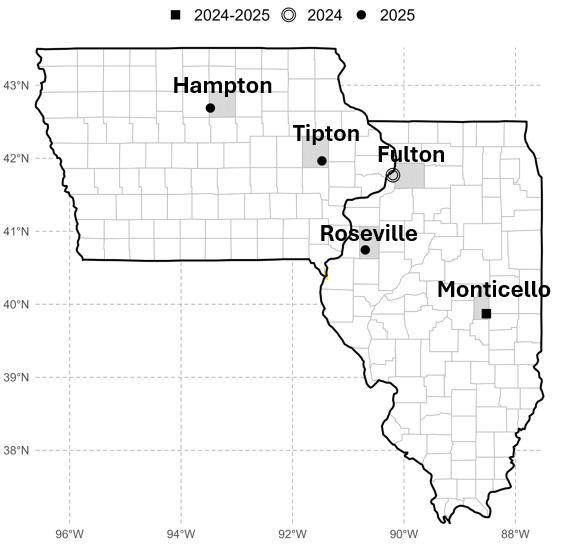
Figure 1 – Trial Locations
A total of 12 treatments were evaluated, representing combinations of four tillage systems including conventional tillage (CT), strip-tillage (ST), no-tillage (NT) and no-tillage with a cereal rye cover crop (NT+CR), along with three liquid starter fertilizer strategies. These included an unfertilized control (UTC), 15 lb. N/acre (N), and 15 lb N plus 10 lb. S/acre (N+S), applied as a 2×2 placement at planting. N was applied as UAN 32%; 32-0-0-, and S as ATS; 12-0-0-26.
Averaged across Illinois sites, we generally observed an early-season (V4 growth stage) response to starter fertilizer. On average, applying 15 lb. N/ac at planting increased biomass by about 17% compared with the unfertilized control. However, this early advantage did not persist through the remainder of the season. By the R2 growth stage, tissue testing revealed that N and S concentrations were similar across all treatments and above established sufficiency ranges reported in the literature; 4.3% for N and 0.265% for S. These results indicate that soybeans eventually met their nutrient needs through biological nitrogen fixation and soil organic matter mineralization, even in the absence of starter fertilizer.
Across all locations and years, soybean grain yield ranged from about 60 to 95 bu/acre, but starter fertilizer did not increase yield in any tillage or cover crop system. This was consistent across individual sites as well as the combined dataset. While soybean grew faster early on with starter fertilizer, this did not translate to higher grain yield.
Differences among tillage systems were relatively small. When averaged across the six site-years, CT and ST both averaged 79 bu/acre, while NT averaged 77 bu/acre. No-till with cereal rye yielded slightly lower at 76 bu/acre (Figure 2). Overall, results highlight the short-term potential to grow high-yielding soybeans under conservation practices, even without starter fertilizers.
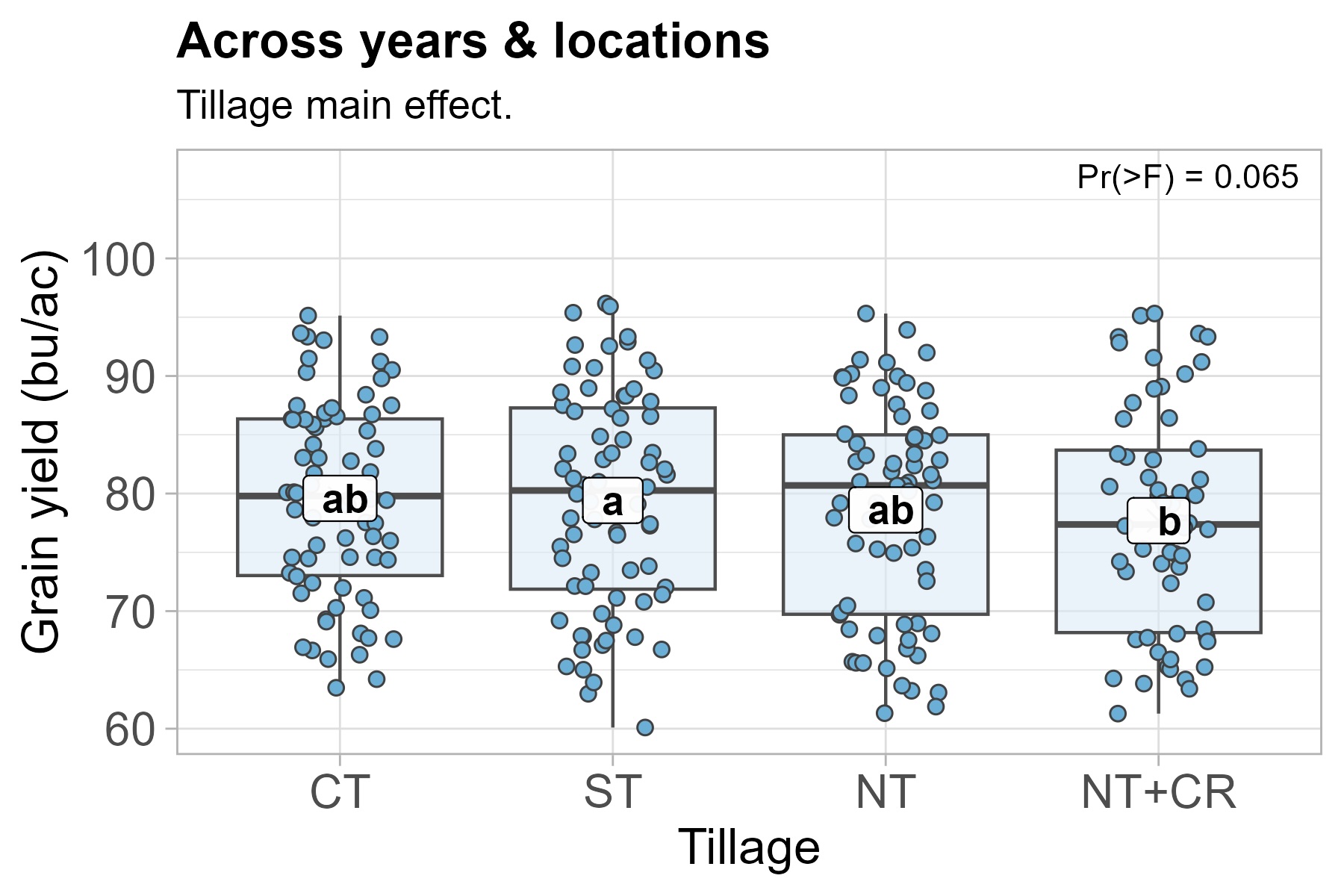
Figure 2. Soybean grain yield across years and locations by tillage system. A significant tillage effect was observed (P = 0.065). Different letters indicate significant differences among treatments at the α = 0.10 significance level based on Tukey’s multiple comparison test.
These findings are particularly relevant when accounting for the costs of tillage operations, estimated at $34/acre for conventional tillage, $26/acre for strip-tillage, no additional cost for no-till and $55/acre for cereal rye cover crop management. In years characterized by low commodity prices and high input costs, management practices that maintain yield while reducing field operations can improve profitability and support soil conservation.
Additional research may be needed to better define the conditions under which starter N and S responses may occur in high-yielding soybean systems, particularly under long-term conservation practices. Factors such as soil compaction and greater plant residue may influence N and S availability and help explain occasional early-season responses.
About the Author: Field Advisor



 and then