
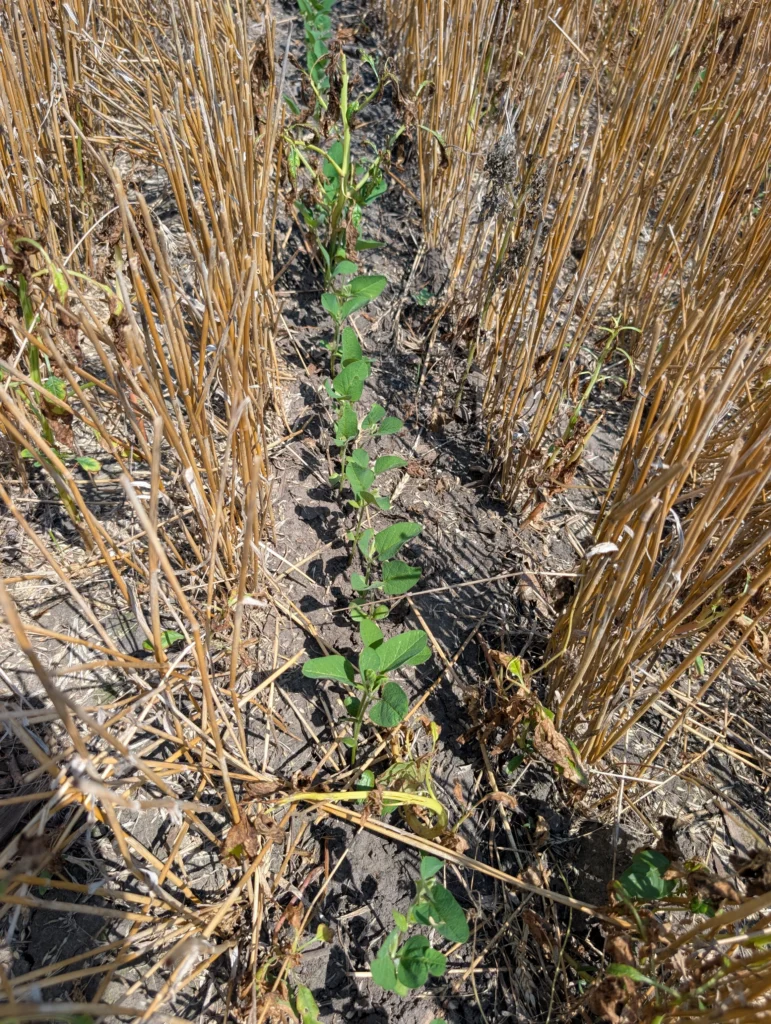
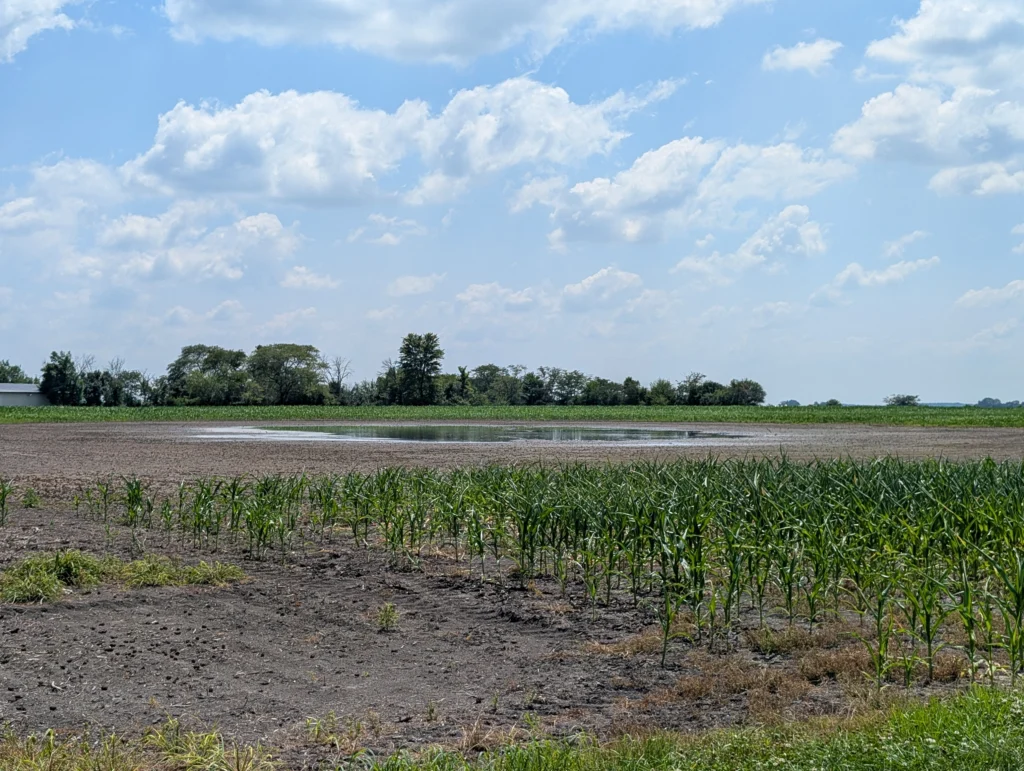
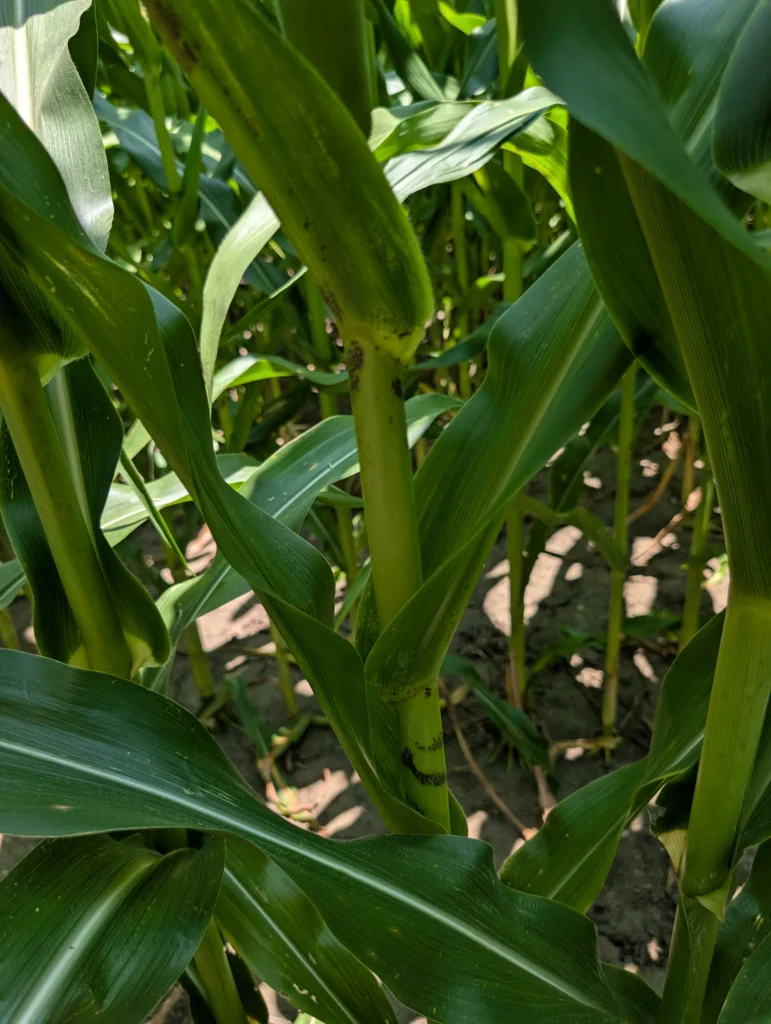
Most corn and soybeans in Douglas County have progressed into flowering stages. The primary exceptions to this are areas of fields where early season inundation led to crop stunting as well as a handful of fields where planting was delayed due to wet conditions, which now contain soybeans. These fields, as well as the few wheat/double-crop soybean fields I found, have soybeans ranging from late VC to early V4. Corn that has entered reproductive growth is still in the early stages, generally R1 (silking) to early R2 (blister). Developing pods can be found in the lower canopy of many soybean fields (R3). Foliar disease issues still appear to be minimal in the county. Low spots in soybean fields still have a visibly lighter color as they try to recover from saturated soil conditions and possible soil-borne pathogen pressure. In corn, I found a couple fields with some Physoderma brown spot/stalk rot symptoms starting to show. This pathogen doesn’t generally cause economic losses, but it may be taken into consideration when prioritizing fields for harvest to minimize loss potential from lodging (https://cropprotectionnetwork.org/encyclopedia/physoderma-stalk-rot-of-corn).
EMAIL SIGN UP
Sign up to receive our newsletter for up-to-date news and offers directly in your inbox:
LINKS
FOLLOW FIELD ADVISOR

The Illinois Soybean Association (ISA) checkoff and membership programs represent more than 43,000 soybean farmers in Illinois. The checkoff funds market development, soybean production and government relations efforts, while the membership program, Illinois Soybean Growers (ISG) and the Illinois Soybean Growers PAC actively advocates for positive and impactful legislation for farmers at local, state and national levels. ISA upholds the interests of Illinois soybean farmers through promotion, advocacy, research and education with the vision of becoming a trusted partner of Illinois soybean farmers to ensure their profitability now and for future generations.
© 2026 Illinois Soybean Association

 and then