I have been educating about fungicides since the early days of widespread foliar applications in corn. As growers began to embrace foliar fungicides about 20 years ago, I spent considerable time developing mode of action resources and working with colleagues who did an amazing job of detailing the mechanics of fungicide applications.
A core principle since the early days of widespread foliar fungicide use has been that fungicides are largely immobile. For this reason, we often stressed the need for “good coverage” and application practices that promote it. We emphasized using high carrier volumes, high pressure and appropriate nozzles in pursuit of small droplet sizes.
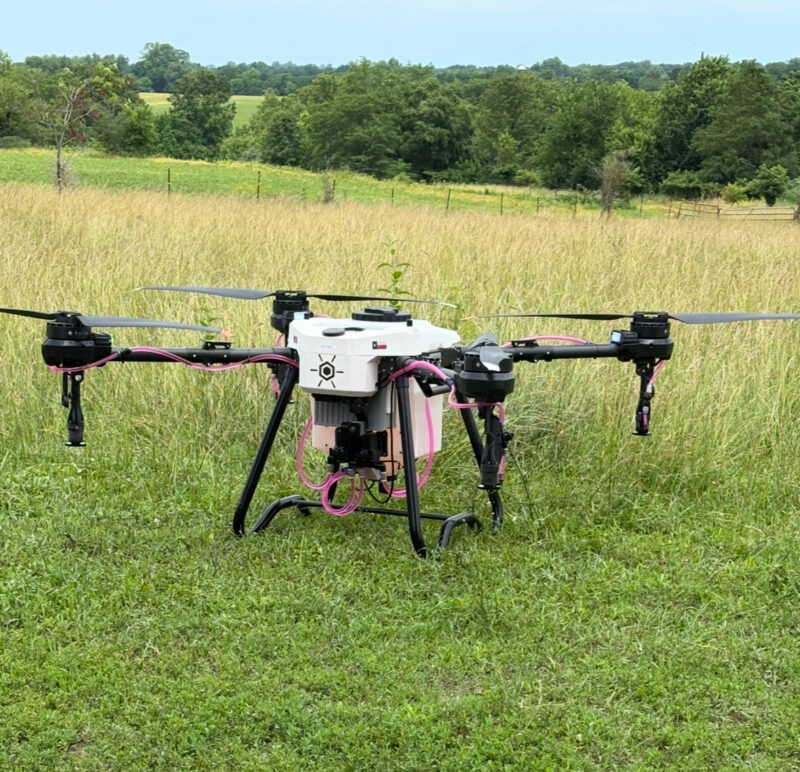
Photo provided by Matt Montgomery, Beck’s Hybrids
A few years ago, a new tool entered the marketplace – drone application units. Through my own experience and research done by my colleague Clayton Stufflebeam, Beck’s PFR agronomist, we have found that drones can be as effective as planes, helicopters and ground application units. How can that be though? It’s surprising because drone carrier volumes and water-sensitive spray cards indicate that we are not getting the kind of small droplet sizes once considered critical.
We do not yet know the specifics as to why drones work, when they seem to violate the core principle of coverage, but we do have some compelling theories.
One theory for drones being an equally effective tool is that they provide more consistent boom-to-target distance. During a recent interview, Stufflebeam said, “I flew this year’s drone at a 10-foot altitude above the crop canopy, and it stayed within 2–3 feet of that height, even across hilly fields.” Rills within the field did not influence that distance. The boom did not jolt off center, and power lines or edge of field obstacles did not require adjustments. The stability may allow drones to compete with other application methods.
Another theory for drones being effective is the downdraft they generate. When a drone application unit is at work, it visibly presses the crop canopy down.
“Drones significantly move the crop canopy,” notes Stufflebeam. “I believe this movement enhances canopy penetration for fungicide applications.”
This theory is supported by observations of aerial applications, which also create a similar “dent” in the crop canopy. Downdraft has been one of my “go to” explanations for why aerial applications work so well.
A third explanation for drone performance is that larger droplet sizes are not as detrimental as we once thought. Producing fine droplets also creates extremely fine particles that are prone to move offsite. Larger droplets, by contrast, may have the momentum to reach the target instead of drifting away.
A final explanation is carrier pH. Stufflebeam noted, “The half-life of pesticides is critical, as higher water pH often reduces pesticide effectiveness rapidly.” The fungicide product used likely has some “acidifying capacity.”
“In our trials, the average starting water pH was 8.08, with consistent water used across all trials,” Stufflebeam said. If the carrier is too basic, the product can degrade rapidly. The fungicide’s acidifying capacity may adjust that carrier pH in a smaller volume, slowing degradation and allowing a slightly higher dose of active ingredient to reach the target – helping drones remain competitive.
There are many theories for why drones seem to work, but the most important point is that they do. The comparison of drone, aerial and ground application is not about one mode of application being better than the other. It is the story of a big toolbox of options being available to the grower. Each system works. Pick the one that best fits your operation, and we will continue to dig into the “why” behind drone effectiveness.
About the Author: Matt Montgomery



 and then