
The fall window for planting cover crops may have closed, but now is the perfect time to learn what impact they had on cash crops during the 2025 growing season. As many farmers know, improper cover crop management can result in a yield penalty, but the right management choices are often unknown or unclear. This is further complicated by Mother Nature, when the management decision you made one year might not be the correct one for the climate a different year. This uncertainty often prevents adoption, because risking an unknown impact on your cash crop is enough to keep you from trying something new when input prices are high.
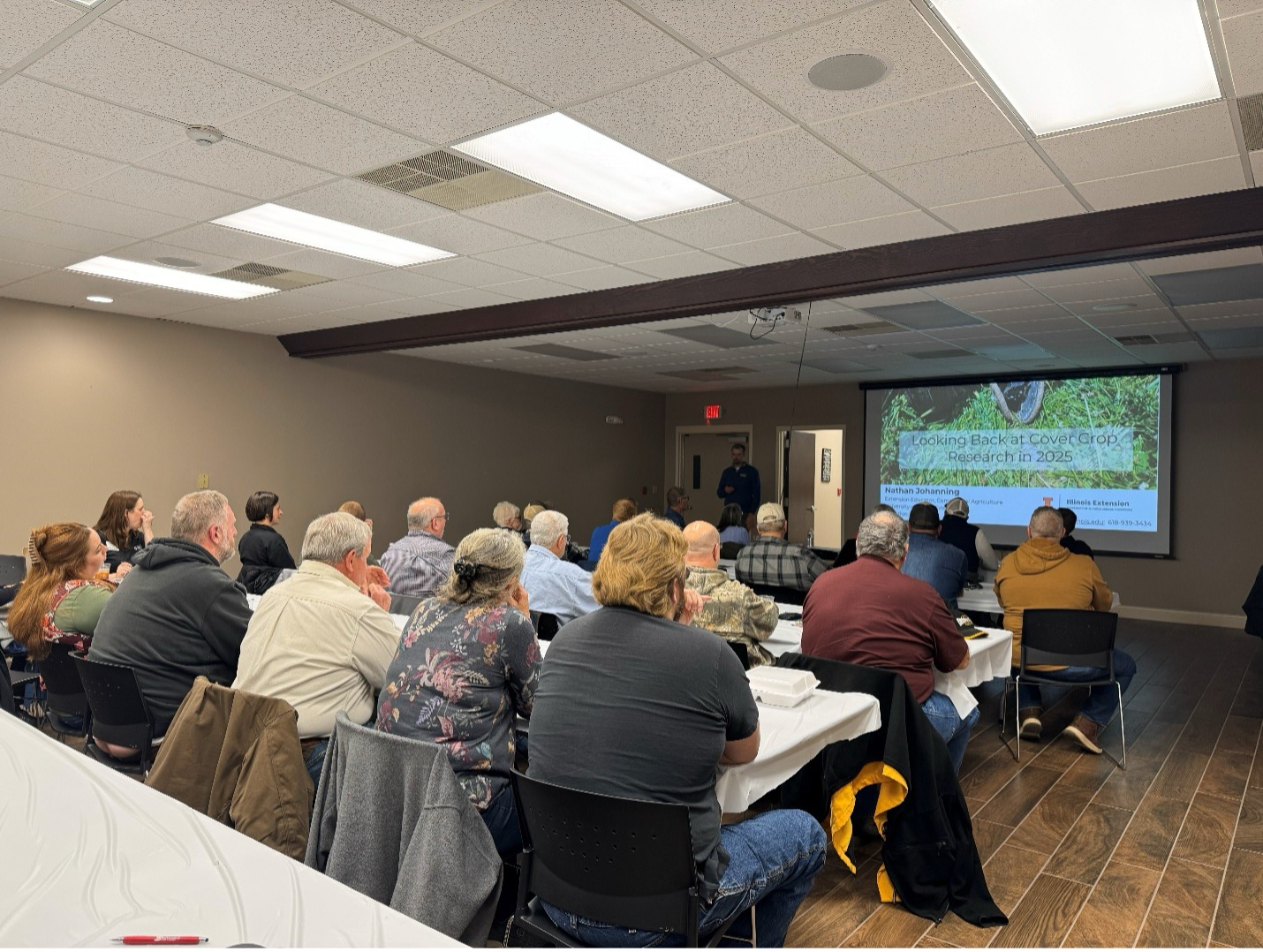
Photo: Darby Danzl, Illinois Soybean Association
Despite some uncertainty around best management practices, there is plenty of science proving that the presence of cover crops provides many benefits to your farm. This leaves a lot of farmers wondering about the best ways to integrate cover crops into their systems. Even farmers who have planted cover crops for years still ask how they can take this practice to the next level.
To help provide farmers with data to guide cover crop decision making, the Illinois Soybean Association (ISA) checkoff program has been funding research conducted by University of Illinois Extension Specialist Nathan Johanning. Johanning highlighted the results of two trials at our “Dinner & Data” event on December 4th in Belleville, Illinois, an event that was organized as a part of ISA’s partnership with the Natural Resources Conservation Service (NRCS). In general, these trials evaluated how different management decisions influenced cover crop establishment and growth, and how those decisions impacted cash crop yields.
Trial 1: Cereal Rye Planting Date and Seeding Rate for Soybean
In the first trial, Johanning focused on the most used cover crop in Illinois: cereal rye. The treatments consisted of three planting dates (mid-October, late October, and mid-November), four drill rates (0, 30, 60, and 120 lb/ac), and two termination timings (at 24 inches tall or at maturity) before planting soybean.
Seeding rate is a big question because fall weather ultimately decides when we can get into the field. We can’t always control planting date, but we can control how much seed goes in the ground. The key is understanding how those rates behave when planted at different times of the year.
The results of this study uncovered two major trends relating to cover crop growth:
- Biomass production essentially doubled when rye was allowed to reach maturity instead of being terminated at 24 inches, regardless of planting date.
- Planting date influenced biomass more than seeding rate, with earlier planting resulting in greater biomass production across all treatments.
These findings can help farmers anticipate biomass potential based on when they were able to seed their cereal rye. Another important takeaway was that neither seeding rate nor planting date affected soybean stands or yields. However, the plots where cereal rye was terminated earlier tended to yield higher in 2025 at Belleville, but in other years termination, did have an influence on yield.
Trial 2: Cover Crop Systems for Soybeans
The second trial Johanning highlighted is his ISA checkoff funded research which expands evaluations to several single species cover crops and cover crop mixes (rates in pounds of pure live seed per acre):
- Cereal rye (50)
- Winter wheat (50)
- Annual ryegrass (15)
- Cereal rye (30), Rapeseed (2)
- Cereal rye (30), Hairy vetch (8)
- Winter wheat (30), Radish (2), Balansa clover (4)
- Annual ryegrass (10), Rapeseed (2), Balansa clover (4)
- Cereal rye (20), Winter oats (20), Annual ryegrass (8), Hairy vetch (8)
These single species cover crops and cover crop mixes were also evaluated for both their biomass production as well as their impact on soybean yields. The data showed that every cover crop mix resulted in a soybean yield that was numerically higher than the control plot, where cover crops were not planted (Table 1). All seed mixes of two or more species, apart from the cereal rye and rapeseed blend, resulted in a soybean yield that was significantly higher than the control plot (Table 1).
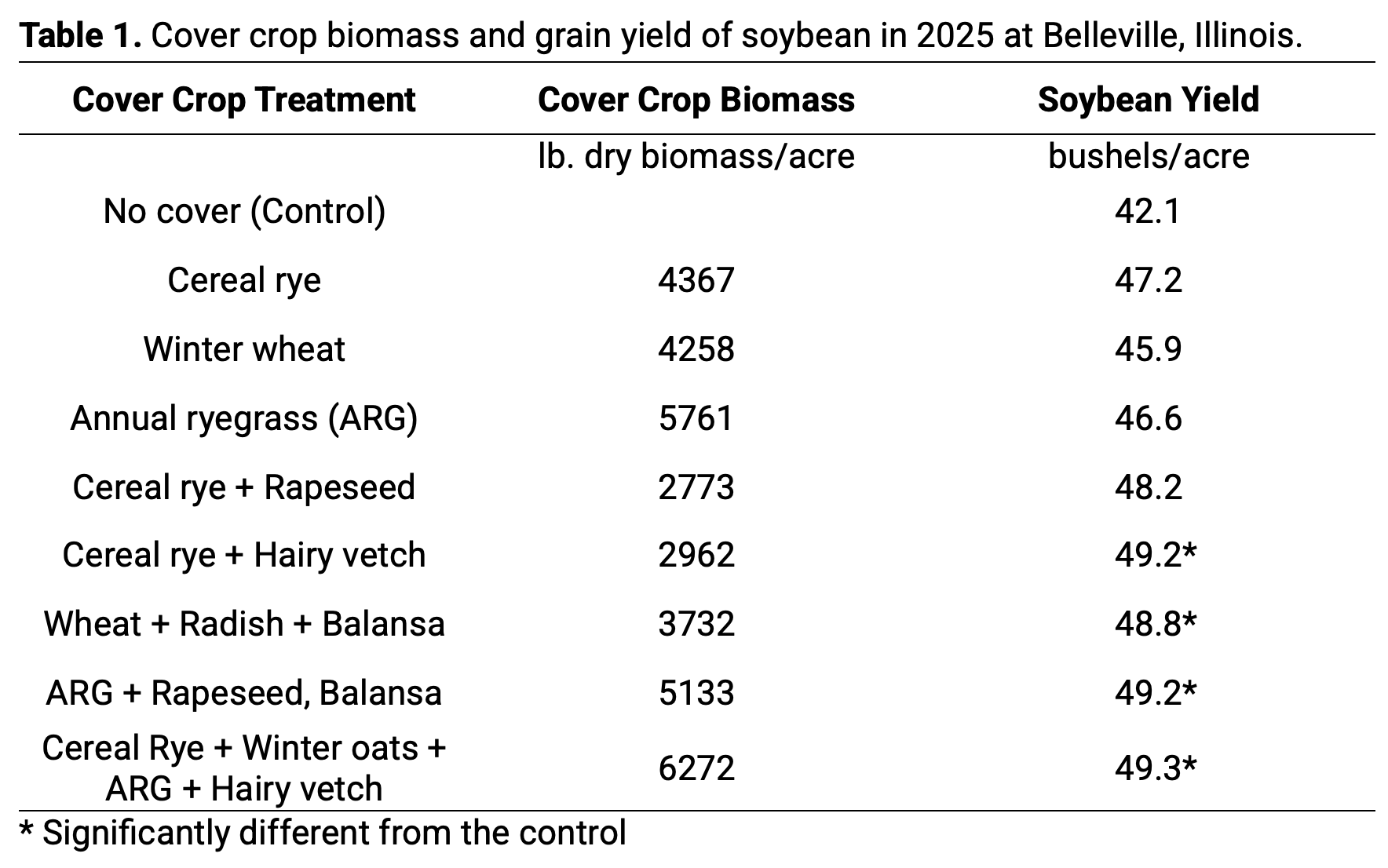
Although soybean yield increases are not always expected following cover crop mixes, it is exciting to see a positive yield response following a cover crop mix, as the mix is often more expensive than planting a single species of cover crops. What caused this positive yield response? Johanning cannot say just yet but with future years of trials like this we hope to understand more.
To get the best return on your cereal rye seed, Johanning suggests planting between 30 and 60 lb./ac of pure live seed and using the high end of that rate range only if weather delays prevent early planting, such as planting after November 1 in southern Illinois. In the fall, every day of growth matters so take advantage of any early planting window you get. Also, pay close attention to spring weather since warm and dry conditions often call for earlier termination. We’ll continue sharing key takeaways from this work through Field Advisor as Johanning pulls together results from multiple years of research into a final report.
To close the event, Abigail Peterson, CCA and ISA’s Director of Agronomy, presented on the economics of cover cropping. She noted that many of the benefits are hard to put a dollar value on because improving soil health is not something that pays off immediately. In her view, much of the value comes from sustaining and improving your soil over time. Degraded soils eventually force farmers to rely on more inputs like fertilizer and weed control, both of which are becoming increasingly expensive. Cover crops and conservation systems may not always “pay” in the traditional sense, but when implemented and managed properly, they provide long-term value that shows up across the entire farm.
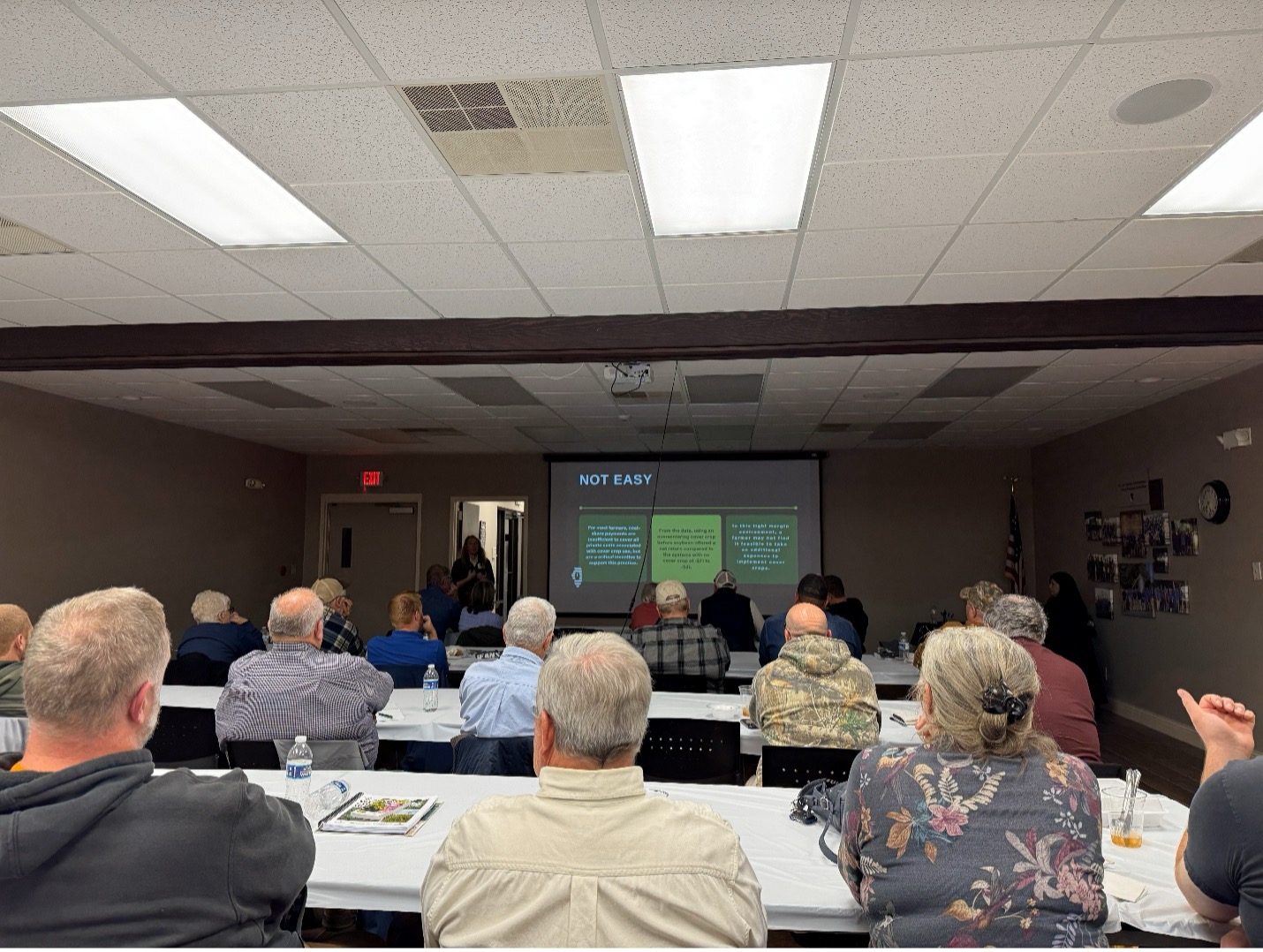
Photo: Darby Danzl, Illinois Soybean Association
Until those long-term benefits are fully realized, farmers may need support to help cover the short-term costs of implementing cover crops. We encourage growers to contact their local NRCS office to learn more about the financial and technical assistance available for conservation practices like cover crops. Because funding options can sometimes be limited or complicated, we also invite farmers to complete our anonymous survey to help us improve and expand program offerings across the state. Additional financial incentives, such as the Fall Cover for Spring Savings program, are also available for the 2026 growing season.
Next spring, ISA plans to host a third event with Nathan Johanning so farmers can see these trials during active growth and better understand how different management decisions play out in the field. We look forward to continuing this work and providing growers with practical, Illinois-focused data that helps make cover crop decisions easier and more profitable.
About the Author: Darby Danzl


 and then