
Sulfur has officially joined the conversation when we are discussing which macronutrients need to be applied to our corn and soybean acres to meet plant demand and support optimal growth. Historically, nitrogen, phosphorus and potassium were the only nutrients required in quantities large enough to justify supplemental applications, as Illinois soils were typically able to supply the other major macronutrients, such as calcium and magnesium. Sulfur, while essential for plant growth, is only just becoming a common addition to fertilizer management plans, and this shift to sulfur is no coincidence.
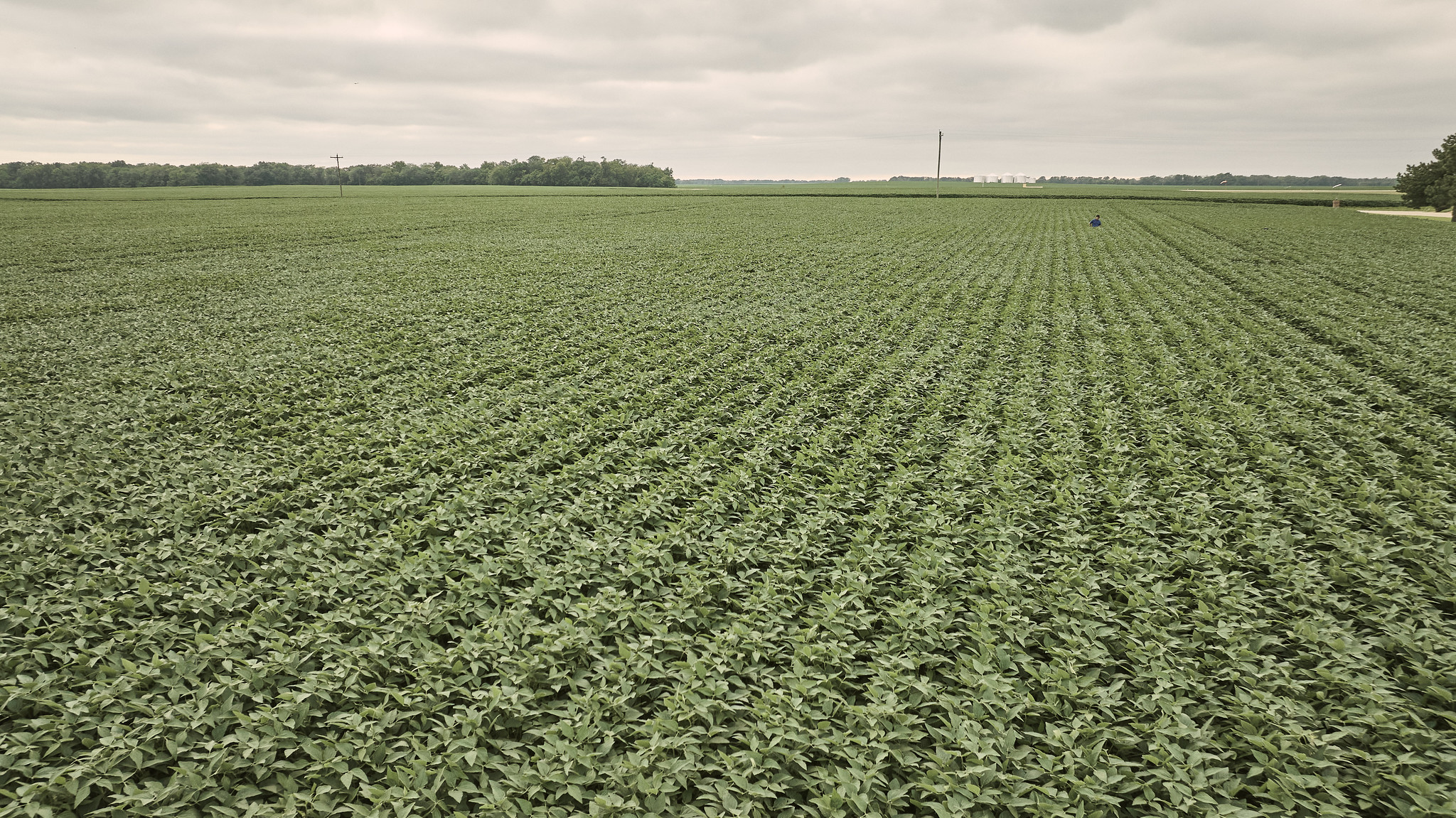
Photo: Illinois Soybean Association
Prior to the 1970 Clean Air Act, coal-fired power plants, smelters, diesel engines and other industrial processes released large amounts of sulfur dioxide into the atmosphere. Once airborne, sulfur dioxide would react with water, oxygen and other compounds and then return to the surface through wet deposition as acid rain or dry deposition as particulate matter. Although harmful to many ecosystems, this atmospheric deposition of sulfate unintentionally supplied the Corn Belt with an estimated 10 to 30 pounds of sulfur per acre annually, which historically prevented the need for intentional sulfur applications.
Since the Clean Air Act began regulating sulfur dioxide emissions, they have been reduced by over 95%, according to recent data from the U.S. Environmental Protection Agency. As a result, the atmospheric supply of sulfur has declined dramatically and is now estimated at only about 1.5 pounds of sulfur per acre per year.
This current sulfur supply is well below crop requirements based on research conducted in the early 2010s by Dr. Ross Bender at the University of Illinois Urbana-Champaign. His work showed that a corn crop yielding 230 bushels will require about 23 pounds of sulfur per acre, and a soybean crop yielding 60 bushels will uptake around 17 pounds of sulfur per acre. The same research also showed that roughly 60% of the total sulfur taken up by both corn and soybeans is removed from the field with the harvested grain. Therefore, in the absence of atmospheric sulfur inputs, farm soils can no longer keep pace with the nutrient demands of these increasingly productive crops. As a result, many high-yielding cropping systems are now believed to be sulfur deficient for both corn and soybeans.
This shift in natural sulfur supply has prompted researchers and farmers to question if sulfur might be a key factor limiting yield potential in Illinois, particularly for corn, which has a relatively higher sulfur requirement compared to other row crops given corn’s relatively high yield levels achieved in the Midwest. Research conducted at the University of Illinois, Iowa State University and Purdue University has shown that sulfur applications can significantly increase corn yields, prompting many farmers to incorporate sulfur into their nutrient management programs.
Although sulfur responses in corn appear to provide a relatively consistent return on investment, soybean responses to sulfur are not as clear. However, Shaun Casteel, Ph.D., Professor of Agronomy at Purdue University, has observed promising soybean yield responses to sulfur applications in Indiana research trials. Casteel’s research has shown an average soybean yield gain of 8 to 10 bushels per acre following sulfur applications, with some responses exceeding 20 bushels. Seeing these numbers has led many farmers to wonder if they should be supplying their soybeans with sulfur as well.
In response to this curiosity, the Soybean Production team at the Illinois Soybean Association initiated sulfur research ahead of soybeans through our On-Farm Trial Network (OFTN). Unlike traditional university research conducted in small, replicated plots at research centers, OFTN recruits farmers from across the state to conduct replicated strip trials in their own fields. In 2025, this sulfur study enrolled 16 farmers statewide to evaluate two treatments: sulfur applied at 30 pounds per acre and an untreated control. This sulfur rate is notably higher than the estimated soybean requirement of 17 pounds per acre for a 60-bushel crop; however, current soybean yields are often higher than 60 bushels per acre, so this rate was selected to ensure sulfur would not be limiting in the treated strips.
One of the strengths of the OFTN is allowing farmers flexibility to adapt trials to their research interests and management systems. Participants were given the option to apply sulfur as either a dry broadcast application of ammonium sulfate (AMS) or a liquid application of ammonium thiosulfate (ATS), both applied preplant. Since both commonly used sulfur sources also supply nitrogen, farmers chose whether to apply an equivalent amount of nitrogen to the control strips to isolate sulfur effects. Most participating farmers selected ATS as their sulfur source and opted not to add nitrogen to the control treatments.
The team is still in the process of analyzing the overall results from soil and tissue samples as well as yield data from all trials. It plans to present key takeaways in spring 2026. In the meantime, we can still look at the preliminary results from individual locations from an economic perspective. Applying an additional nutrient to your field, especially if it requires an additional equipment pass, has obvious implications in terms of cost. Therefore, many farmers want to understand not only the yield response to sulfur but also the overall return on these applications. At the end of the day, farming is a business, and to justify the cost, sulfur applications need to pay.
For this preliminary economic evaluation, only factors that differed between treatments were considered, including soybean yield, the price of grain at the time of harvest, sulfur product cost and application cost. Soybeans in October 2025 were $10 per bushel, ATS was priced at $320 per ton and the estimated cost of the sprayer application was $6.50 per acre (Table 1). All other management practices were consistent across treatments and therefore excluded from this analysis.
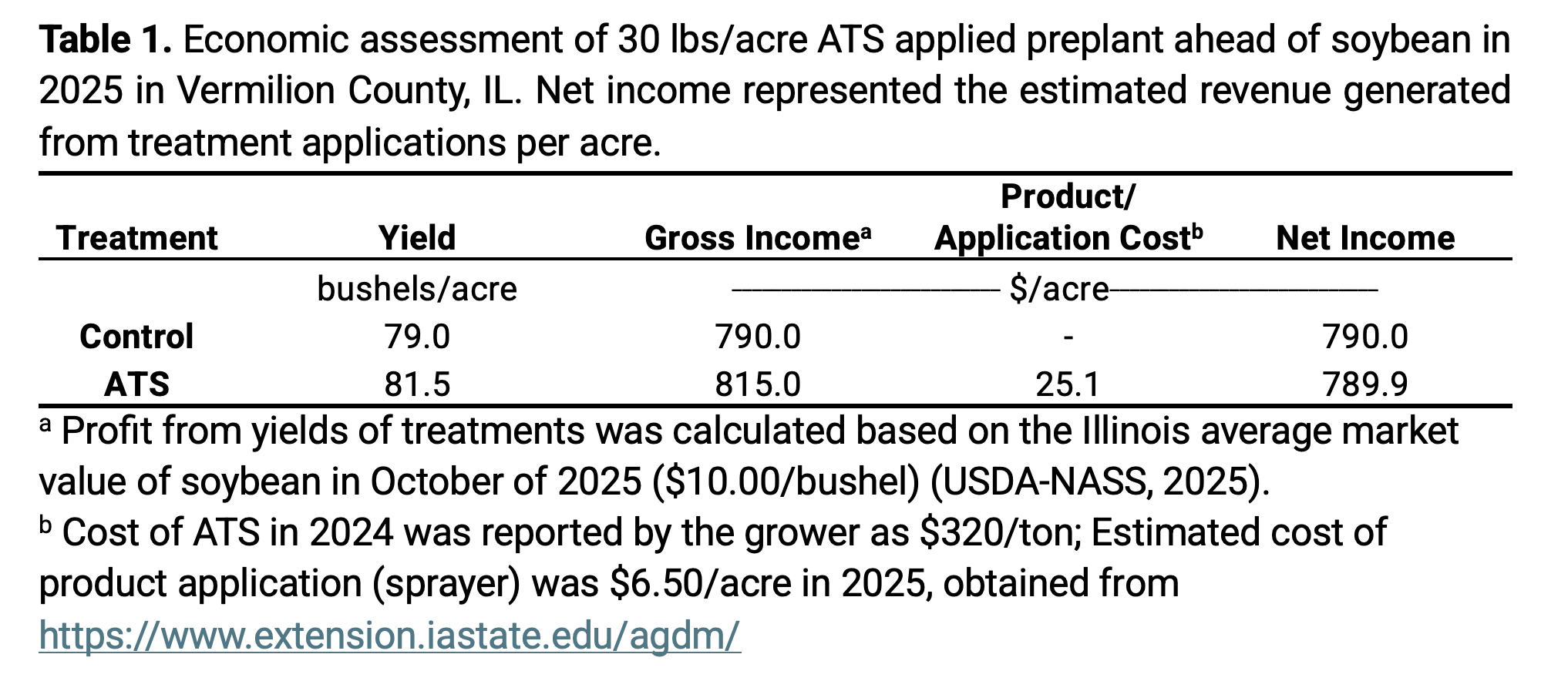
Yield results from one OFTN research site in Vermilion County showed a numerical increase in soybean yield of 2.5 bushels per acre, or about 3.2%, in response to the ATS application. Using the values previously described to estimate economic return, this yield increase was enough for the farmer to roughly break even, with the added revenue nearly covering the cost of the sulfur application itself (Table 1). Although this was not a large economic win, the response suggests sulfur might have contributed positively under these conditions.
One factor in this equation to call out is application cost, as farmers might not necessarily make a separate pass to apply ATS in the spring. Many already apply preplant burndown herbicides, in which case ATS can be included in that application at no additional cost, effectively providing a “free ride.” Additionally, ATS can be applied at planting with a 0x2 surface dribble or incorporated with a 2×2 band. Either way, removing the application cost from this equation would result in a modest economic return from the ATS application in the Vermilion County example.
This “free ride with your herbicide” approach can offer additional benefits in cover-crop systems, as ATS often increases leaf burn on green tissue, which improves burndown effectiveness. In addition, the nitrogen supplied by ATS might help stimulate microbial activity, accelerating residue breakdown and nutrient release in situations where nutrient immobilization or availability are concerns.
There are, however, important caveats to the “free ride” approach, as ATS is not compatible with all herbicides and might salt out in certain tank mixes. A jar test should always be conducted before attempting any ATS and herbicide mixture to avoid compatibility issues. Furthermore, due to its potential to cause significant burn on green tissue, ATS should not be applied after crop emergence, nor should it be applied directly in-furrow, as it can cause seedling toxicity. Understanding these limitations is key to determining when and how ATS can be incorporated into a spring application program and avoid the cost of an additional application.

Photo: Illinois Soybean Association
Part of making this decision also involves considering sulfur application costs, which can vary significantly from year to year. For the Vermilion County farmer, ATS prices increased from $320 per ton in the fall of 2024 to $400 per ton in the fall of 2025. At this higher price point, the sulfur application would not have been economical given the yield response observed in 2025.
For growers interested in trying sulfur ahead of soybeans, keep in mind that a 30-pound-per-acre rate is not necessarily required to induce a yield response. In this case, sulfur cost the Vermilion County farmer approximately $0.62 per pound of sulfur, resulting in a per-acre cost of about $18.60. Further economic improvements and reduced financial risk could be achieved by reducing the application rate to match expected yields (0.28 pounds of sulfur per bushel) while considering soil sulfur availability, or by integrating sulfur applications into an existing field pass to avoid redundancy.
Overall, this represents only one site-year of data from a single Illinois farm and should not be interpreted as a definitive recommendation. However, it reinforces the importance of evaluating sulfur not only from a yield standpoint but also through an economic lens. Although sulfur applications might not result in dramatic 20-bushel yield increases in every field, smaller consistent responses can still pay when costs are managed, and applications are integrated into existing field operations.
Darby Danzl is the Regional Technical Agronomist for the Illinois Soybean Association (ISA). In her role, she contributes to on-farm trials, outreach efforts and NRCS partnership responsibilities.
Darby Danzl holds a B.S. in Environmental Economics and Policy, a minor in Horticulture, and an M.S. in Crop Sciences from the University of Illinois at Urbana-Champaign. Her graduate research at the Crop Physiology Laboratory involved small-plot research with a focus on soil health and regenerative agricultural practices. She is passionate about advancing agricultural sustainability using science-based practices that improve soil health, increase resource efficiency, and boost long-term productivity.


 and then
FIND US ON